Gorean Glossary C
Gor is a complex lifestyle based on a series of novels by John Norman featuring a strict caste system of highly trained Free and slaves. For more information, check out the Garden's section on Gor.
Note about this Glossary: items marked with a K are Kassar or Old Gorean, online-created languages used to augment Gorean. Kassar was not created or endorsed by John Norman and is not consistent within the Gorean language or universe. Kassar should be used cautiously and sparingly as many Goreans do not use or approve of the language.
Cabbage |
Round, green leaf vegetable. |
Cacao Tree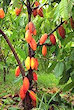 |
Tree no doubt brought from earth, grown in the tropics and obtained by the merchants of Cos. |
| Cage Cart/Cage Wagon | Literally, a cage with wheels, used for transporting animals, including slaves. |
| Cage Girl / Deck Cage Girl | Slave girl that gets the privilege of riding on a cargo ship on the deck in a deck cage |
| Caliph | A high ranking official amongst the desert nomadic tribes. |
| Calligraphic | In reference to Tarl's comments on how perhaps some of the letters of the Gorean alphabet derived, calligraphic refers to as follows: "Works in fine handwriting considered as a group; beautiful handwriting." - American Heritage College Dictionary, Third Edition ©2001 e Gorean alphabet has twenty-eight characters, all of which, I suspect, owe their origin to one or another of the alphabets of Earth. Several show a clear-cut resemblance to Greek letters, for example. 'Sidge', on the other hand, could be cuneiform, and 'Tun' and 'Val' are probably calligraphically drifted from demotic." - Explorers of Gor, pages 9-10. |
| Camerius | the third month of the Gorean calendar (in Ar and some other cities) See Selnar |
camisk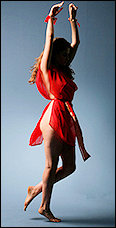 |
simple, poncho-like slave garment, about 18" wide; (common): It is a single garment for a female slave. The common camisk is a single piece of cloth, about eighteen inches wide, thrown over the girl's head and worn like a poncho. It usually falls a bit above the knees in the front and back and is belted with a cord or chain. (Nomads of Gor, book iv, page 90). (Turian): The Turian camisk, on the other hand, if it were to be laid out on the floor, would appear somewhat like an inverted "T" in which the bar of the "T" would be beveled on each side. It is fastened with a single cord. The cord binds the garment on the girl at three points, behind the neck, behind the back, and in front of the waist. The garment itself, as might be supposed, fastens behind the girl's neck, passes before her, passes between her legs and is then lifted and, folding the two sides of the T's bar about her hips, ties in front. The Turian camisk, unlike the common camisk, will cover a girl's brand; on the other hand, unlike the common camisk, it leaves the back uncovered and can be tied, and is snugly, the better to disclose the girl's beauty. (Nomads of Gor, book iv, page 90) |
| Camp Singers | That clan of the Wagon Peoples whose role is to keep the oral literature of the Wagon Peoples. |
| Campaign Tent | So named as they are found within military camps in the field, especially, large fixed camp. Circular with conical roofs, these tents do not serve strictly the tarnsmen, but rather both ground and air troops. It's the responsibility of the ground troops to transport these tents via supply wagons of the main body. |
| Canal Urt | One of the several varieties of rodents which plague Gor. |
| Cancega | The term in the language of the red savages for "drum" though literally it means "a skin stretched over a hoop." The term "cega" on its own means pot or kettle, and therefore, "cancega" can be translated to "kettle skin" or "pot skin" if one wants to be literal. |
| Canhanpisasa | The term in the red savages language meaning "candy." |
| Canhanpitasaka | The term in the red savages language meaning "lumps of cake sugar." |
| Canhanpitikica | The term in the red savages language meaning "dried molasses." |
| Canhpi | The term in the language of the red savages for tomahawk; a long handled weapon, bladed in stone. I've seen other "reliable" (and one official) sites describe the head of the canhpi as being made of steel or obsidian glass; nowhere in the books is this stated. In fact, only on page 9 of Blood Brothers of Gor is it mentioned that the canhpi is a tomahawk with a brief description. Only two other places in the book is the canhpi somewhat described. Upon researching the tomahawk of the Native Americans, the tomahawk were made of stone and wood - that is, until the arrival of the Europeans. Ornately incised, feathered, globe-headed clubs used for ceremonies as well as war, have also been called tomahawks among the Native Americans. |
| canjellne/kajira canjellne | Literally means "slave challenge." When a Gorean cries, "Canjellne!" he is challenging for ownership of a slave. A circle is then drawn by the one being challenged, the slave then placed within this circle for the duration of the fight, the spar commences with the ritual of the spear casting. This is a play on the Warrior Codes regarding sword-right. There is no evidence that such is conducted with a warrior's choice of weapons, as typically, warriors of Gor were always equipped equally. |
| Canka | The term in the language of the red savages meaning "fire-steel." |
| Canopy Zone | This ecological zone is the second level of the rainforest, ranging between 60 feet Gorean to 125 feet Gorean, situated between the lofty emergents and the ground zone. It is best described as that blanket of green a tarnrider might think it to be as he flies over the jungle. In this level, several varieties of birds can be found, however, snakes, insects and small animals may also be found here. |
| Canpasapawi/ Takiyuhawi | In the language of the red savages, term meaning the moon when the chokeberries are ripe; one of the summer moons |
| Canwapegiwi | In the language of the red savages, term meaning the moon in which the leaves become brown; one of the autumnal moons. The autumnal equinox occurs during this moon. |
| Canwapekasnawi / Wayuksapiwi | In the language of the red savages, term meaning the moon when the wind shakes off the leave or the Corn-Harvest Moon; one of the autumnal moon. |
| Capacian Baths | One of the most luxurious of bath houses, located in the city of Ar. |
| Captain | Military rank. |
| Capture Cell / Capture Cubicle | a room designed or arranged for the capture of an unwary Free Woman, normally this captured Free Woman is then enslaved. Book 25: Magicians of Gor, page 42 |
| Capture Feast | Feast honoring a young warrior's Mission of the First Capture. |
| Capture Knot | A knot used by Warriors in binding slaves; should the slave struggle while bound this way, the knot is made in such a way that it will continue to tighten with each struggling movement. Warriors are trained this particular knot, and most can perform the binding in less than three Ihn. |
| Capture Loops | Used by Slavers; lassoes made of leather formed with slip knots dropped over a leg, head or arm and pulled tight. |
| Capture Nets / Nets | Netted rope used in capturing wild animals, slaves, and such in times of hunt, raid and war. The use of the net with the trident is popular amongst the fishermen caste. |
| capture scent | An anesthetic used in the capturing of women; soaked in a rag and scarf, and held over the nose and mouth for five (5) Ihn will render a female unconscious. Most probably chloroform. |
| carnarium | refuse pit Book 25: Magicians of Gor, page 38 |
| Carpenter | Person skilled at building things from wood. |
| carpet plant | a plant of the rainforest area inland of Schendi, having tendrils that are sometimes used as a source of drinking water |
Carrot |
A root vegetable; the staple of Bugs Bunny. |
| cart | a gorean compass point equivalent to south west; the river Cartius was so named because of it's direction from Ar southwest. Book 4: Nomads of Gor, page 3 |
| Cartius | Once thought to be one huge river, discovered later by the explorer Shaba to be three distinct rivers: the Cartius proper, the subequatorial Cartius and the Thassa Cartius. |
| Carvel-Built | Refers to the method of ship building; in a carvel-built ship, the ship is built from wooden planks with flush seams. |
| Casmu | The term in the Kaiila dialect of the red savages meaning "sand." |
| Casmu Band | a sub-group of the Yellow-Kaiila Riders |
| caste | "Whereas caste membership is commonly connected with the practice of an occupation, such as agriculture, or commerce, or war, there can be, of course, caste members who are not engaged in caste work and individuals who do certain forms of work who are not members of that caste commonly associated with such work. Caste commonly, though not invariably, is a matter of birth. One may, too, be received into a caste by investment. Normally mating takes place among caste members, but if the mating is of mixed caste, the woman may elect to retain caste, which is commonly done, or be received into the caste of the male companion. Caste membership of the children born of such a union is a function of the caste of the father. Similar considerations, in certain cities, hold of citizenship. Caste is important to Goreans in a way that is difficult for members of a non-caste society to understand. Though there are doubtless difficulties involved with caste structure the caste situation lends an individual identity and pride, allies him with thousands of caste brothers, and provides him with various opportunities and services. Recreation on Gor is often associated with caste, and tournaments and entertainments. Similarly, most public charity on Gor is administered through caste structure. The caste system is not inflexible and there are opportunities for altering caste, but men seldom avail themselves of them; they take great pride in their castes, often comparing other's castes unfavorably to their own; a Gorean's caste, by the time he reaches adulthood, seems to have become a part of his very blood and being; the average Gorean would no more think of altering caste than the average man of Earth would of altering his citizenship, from, say, American to Russian, or French to Chinese. The caste structure, in spite of its many defects, doubtless contributes to the stability of Gorean society, a society in which the individual has a place, in which his work is respected, and in which he can plan intelligently with respect to the future." (Slave Girl of Gor pg. 212 -- 213 ) "Caste memberships, for Goreans, is generally a simple matter of birth; it is not connected necessarily with the performance of certain skills, nor the attainment of given level of proficiency in such skills. To be sure, certain skills tend to be associated traditionally with certain castes, a fact which is clearly indicated in caste titles, such as the Leatherworkers, the Metalworkers, the Singer, and the peasants. A notable exception is the generalization that woman of a given caste normally do not engage in caste work is in the caste of physicians, whose woman are commonly trained, as are boys, in the practice of medicine. Even the physicians, however, normally do not admit their woman to full practice until they have borne two children. The purpose of this is to retain a high level of intelligence in the caste. Professional woman, it is well understood, tend not to reproduce themselves, a situation which, over time, would be likely to produce a diminution in the quality of the caste. Concern for the future of the caste is thus evinced in the limitation by the physicians on the rights of their woman to participate without delay in the caste craft. The welfare of the caste, typically, takes priority in the Gorean mind over the ambitions of specific individuals. The welfare of the larger number of individuals, as the Goreans reason, correctly or incorrectly, is more important than the welfare of a smaller number of individuals. I do not argue this. I only report it." (pg 211 Fighting Slave of Gor) |
| Caste Brother | Reference to a fellow caste member. |
| Caste Codes | The ethical teachings, a collection of ancient sayings, independent of the claims and propositions of the Initiates. |
| Caste Discipline | Martial law in a peasant village. |
| Caste Leader / District Leader | Groups of peasant villages form Districts; a leader is chosen to represent this District. Each village has a Caste Leader. In the smaller villages, they do not have the political structure as their larger counterparts, the cities. Therefore, instead of an Administrator or a Ubar, the leader of their village is the caste leader, as all in the villages are of the Peasant Caste. |
| Caste Sanctuary | The state of seeking safe haven. As on Earth, a person may seek sanctuary of the church and be safe from the laws, it is similar on Gor. Each caste allow for such sanctuary amongst its members |
Catapult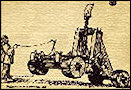 |
A siege engine. |
| catapult, cordage of | Ropes and cords used with the catapults, often made of female hair due to its resiliency, strength and weather resistance. An example of how the female slave on Gor, 'earns her keep'. Even her hair, described as soft, glossy, silky and resilient, stronger than vegetable fibers and more weather resistant, is used, shaved from her head, as raw material for catapult cordage. Book 18: Blood Brothers of Gor, page 245 Book 21: Mercenaries of Gor, page 302 Book 24: Vagabonds of Gor, pages 8 and 44 Book 25: Magicians of Gor, page 49 |
| Cat's Cradle Game | A popular game amongst many of the peoples of Gor, similar to the cat's cradle of earth. |
| Caulking | Substance used to seal boat seams. |
| Cega | The term in the language of the red savages for a kettle, pot, pail, bucket, et al. |
| Celane Melons | This is another example of the rampant misinformation that plagues many Gorean sites. There is no such melon on Earth or on Gor. Throughout my research, I did happen upon the term "celane." It's a Latin term that loosely means "mankind." "Jatropha hedges were largely replaced in Senegal more than twenty years ago by two other euphorbias, known locally as celane and celane toubab. These were promoted by the agriculture extension service because they are very dense growing, and therefore make an even more effective barrier to wind and livestock than jatroha curcas. Farmers are familiar with jatropha and fondly remember its utilization for village soapmaking and as a topical antiseptic. A few farmers have begun the difficult task of replacing their celane, which has a caustic latex that burns the eyes, with jatropha hedges." - ATI Project in Senegal - Celane, is a euphorbic plant, which means, you definitely don't want to be eating it! There are, however, unspecified varieties of melons mentioned in the books. |
| Cell | A secure compartment for the holding of prisoners and slaves. Special cells are often found for certain special captures, such as a face-stripped free woman or a slave intended for a particular training. |
| Cell for Special Captures | In the House of Cernus, this was a cell Cernus created and reserved for certain captives he found of special interest. |
| Cell Spider | Familiar eight-legged creature which inhabit the prison cells. |
Censer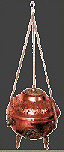 |
An incense burner, usually used in religious ceremonies. |
| Center Defense | A Kaissa move. |
| Centian Opening | A Kaissa move. |
| Centipedes | Multi-appendaged bug. |
| Central Cylinder | In Ar, this serves as the home to the Administrator/Ubar, as well as his court. |
| Ceremony of Citizenship | A rather lavish ceremony in the city of Ar, in which the young Free pledge themselves to Ar as their Home Stone. |
| Ceremony of Companionship | Such ceremonies differ by cities and cultures on Gor. |
| Cernus, House of | One of the largest slave houses located in Ar. |
| Cesli | In the language of the red savages, this term means dung, either men or animals. |
| Cespu | In the language of the red savages, this term means wart or scab. |
| Chain and Claw Brand | Brand of Kurii slaves. |
| chain daughter | sa-fora |
| chain luck | the attempt to capture a slavegirl without having a particular target in mind |
| Chain Mail | Prohibited on Gor sanctioned by the Priest-Kings. |
| Chain Master | A free male in the house of a slaver that oversees the duties, chores, training, and discipline of slave girls. |
| chain, display | the arrangement of kajira on the chain may be determined by a variety of considerations, aesthetic and psychological. For example, blondes be alternated with brunettes, voluptuous girls with slim, vital girls, aristocratic girls with sweet, peasant wenches and so on. Sometimes a girl is placed between two who are less beautiful, to enhance her beauty. |
| chain, marching | the configuration of how kajirae are placed in a coffle for movement. Usually the tallest girls lead the slave chain, the height decreasing gradually toward the end of the chain, where the shortest girl is placed. |
| Chained on Boards / Exposure on Boards | An ancient form of execution in which the offender is chained by means of collar and shackles on parallel upright boards. It is a long, tortuous death, often taking two to three days. This means of execution is most common in harbor cities. |
| Chairs | Though found on Gor, chairs are not generally found in private homes. Chairs are reserved for such dignitaries as administrators and judges. |
| chalwar | baggy pants of diaphanous silk, worn by slavegirls of the Tahari; similar to the harem trousers of Earth |
| Chamber Chronometer | A time-telling device; a clock. |
| Chamber of Irons | The branding room in the house of a slaver. |
| Chamber of Submission | A place where a slave girl must submit totally to the will of men. |
| Chamber of the Council | The Council (representatives of the High Castes) meeting room found in usually every city. |
| Chamber of the Golden Mask | The throne-room of the Tatrix of Thorna. The golden mask that adorned the throne room was later destroyed by the command of the Tatrix, Lara. |
| Chamber of the Mother | The very large chamber which houses the Mother of the Priest-Kings. |
| Chamber of the Power Plant | Blue domed building which housed the main source of power for the Nest of the Priest-Kings. This was, incidentally, destroyed during the Nest Wars, although an emergency back-up was secretly built by those that foresaw such a need. Sometimes this dome was referred to as the Home Stone of all Gor. |
| Chamber of the Urts | One of the torture chambers in the palace of the Tatrix of Tharna. |
| chamber slave | slave of the Priest Kings restricted to use within a particular chamber; these slaves cannot leave the chamber and are to serve the Freeperson living there fully. Book 3: Priest Kings of Gor, page 36 |
| Chaq | Cock |
| Chaqua/Koka | Chocolate, Cocoa |
| Char | a minor tribe of the Tahari; they are a vassal tribe of the Kavars |
| chatka | the strip of black leather, some 6 inches by 5 feet long, worn like a breech-clout over the curla by the slavegirls of the Wagon Peoples |
| Chatka and Curla | A paga tavern in Cos. |
| Chemical Brand | Not technically a brand, but rather a way of marking, practiced by agents of the Kurii, this particular brand is invisible unless activated by a reagent. |
Cherry |
A tree which bears a small red fruit of the same name, grown in Tyros. |
| Chis, Chisa | joke |
| Cho | Shave chocolate into bottom of mug, top with hot paga, add whipped bosk cream and a few more chocolate shavings to the top. Not in the books. |
| Choke Collar | Made of metal and leather, used in conjunction with a leash; intended to compel obedience with a simple tug. |
| Choke Leash | Made of metal and leather, used in conjunction with a leash; intended to compel obedience with a simple tug. |
| Chokecherry | A tree which bears a small red fruit of the same name, grown in the Barrens; the black cherry. |
| chronometer | "...I drew forth from my robes a small, flat, closed Gorean chronometer. It was squarish. I placed it in the hands of the boy, Achmed. He opened it. he observed the tiny hands, moving. There are twenty hours, or Ahn, in the Gorean day. The hands of the Gorean chronometers do not move as the hands of the clocks of the Earth. They turn in the opposite direction. In that sense, they move counterclockwise. This chronometer, tooled in Ar, was a fine one, sturdy, exact. It contained, too, a sweeping Ihn hand, with which the tiny Ihn could be measured. The boy watched the hands. Such instruments were rare in the Tahari region." (Tribesmen of Gor, book x, pages 61-62) |
| chronometric sleeping mat | mat with power switch and chronometric temperature device which may be set to have the mat turn cold before the first light as one has little inclination to remain in a freezing bed. The mat is rolled up or folded back after each use. Book 1: Tarnsman of Gor, page 60 |
| Chronometric Temperature Device | A device that is placed in sleeping mats to keep the bed at a comfortable temperature for the sleeper; the Gorean form of an electric blanket. It can be used as a sort of alarm clock as evidenced by Tarl Cabot. |
| Cinnamon | A tree which produces a fruit bearing the same name, generally ground into a sweet spice which is a main export of the Schendi region; also has medicinal value. |
| Cinto | In the language of the red savages, the term which indicates positive acknowledgment (i.e, "certainly", "surely", "yes"). |
| Circle of the Torch | In the peasant village game similar to Girl Catch, the circle of the torch is where captured girls are returned and then raped. |
| Cistern | A water reservoir. |
| Cities of Dust | the land of the dead |
| City of Silver | The city of Tharna. |
| City of Tents | After the fall of Marlenus, the city of Ar was left in turmoil. This, of course, left wide-open, a chance for scavengers, armies of other cities, and such, to come to Ar, and take what they could, be it slaves, money or the city of Ar itself. One such army, formed of fifty cities, camped outside the city walls while amassing their force, thus becoming known as the City of Tents. |
| Civitatis | Literal translation: "city;" "of the city." |
| Clad Kajir | (to be clad kajir): Among the Wagon Peoples, to be clad Kajir means, for a girl, to wear four articles, two red, two black; a red cord, the Curla, is tied about the waist; the Chatka, or long, narrow strip of black leather, fits over this cord in the front, passes under, and then again, from the inside, passes over the cord in the back; the Chatka is drawn tight; the Kalmak is then donned; it is a short, open, sleeveless vest of black leather; lastly the Koora, a strip of red cloth, matching the Curla, is wound about the head, to hold the hair back, for slave women, among the Wagon Peoples, are not permitted to braid, or otherwise dress their hair; it must be, save for the Koora, worn loose. For a male slave, or Kajirus, of the Wagon Peoples, and there are few, save for the work chains, to be clad Kajir means to wear the Kes, a short, sleeveless work tunic of black leather. (Nomads of Gor, book iv, page 30) |
| Clark, House of | Large slave house. |
| Claws of the Sleen, Rite of the | A blood-brother ritual of tearing the flesh with the claw of a sleen, then mixing the blood. This ritual is done after one saves the life of another. The one whose life was saved, then, owes a returns debt should the other be in danger for his life. |
| Clay Tablets | Small, glazed tablets made of clay, used as betting markers at tarn races. |
Clepsydra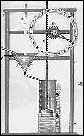 |
A clock which uses the gradual flow of water to tell time. |
| Clienthood | A coalition of sorts between ship captains and a Ubar; safety in return for taxes, performance of services, etc., paid to such Ubar; an Ubarate of sorts. |
| Closed Fist | At an auction, a closed fist by the auctioneer signifies that a bid was accepted. |
| Cloth Worker, Caste of | One of the low castes. |
| Clover | Low growing, three-leafed plant. |
Cloves |
A tree which bears fruit of the same name; export from the Bazi region; used as a spice but has medicinal value as well. |
| Coach | A public or rented wagons for the transportation of passengers, often slung on layers of leather (in effect: shock absorbers) to give a more comfortable ride. It seems free women, however, are the most commonly afflicted with motion sickness in these coaches. |
| Code of the Warrior | To each Caste there is a standardization of rules, etiquette, etc., by which each person of that caste adhere to. Or should adhere to. The Warrior Code is a set of standards amongst warriors. |
| coffle | a chained line of slaves |
| Coffle Collar | The coffle collar includes several types of steel collars with front and/or back rings so as to enable the slaver to secure several girls on one chain, with three (3') to four (4') lengths of chain between them. |
| Coffle Line | A method of chaining a line of slaves together for trekking. |
| coin girl | a slave who wears a coin box and bell around her neck and is available on the street for sexual use to earn money for her Master |
| Coin Merchant | The Gorean banker; a sub-caste of the Merchants Caste. |
| coinage | To be sure, much seems to depend on the city and the particular weights involved. For example, a 'double tarn' is twice the weight of a 'tarn'. It seems there are usually eight tarsk-bits in a copper tarsk, and that these are the result of cutting a circular coin in half, and then the halves in half, and then each of these halves in half. An analogy would be the practice of cutting the round, flat Gorean loaf of sa-tarna bread into eight pieces. There are apparently something like one hundred copper tarsks in a silver tarsk in many cities. Similarly, something like 10 silver tarsks would apparently be equivalent, depending on weights, etc., to one gold piece, say a single 'tarn'. Accordingly, on this approach, the equivalencies, very approximately, and probably only for certain cities, would be eight tarsk bits to a copper tarsk; one hundred copper tarsks to a silver tarsk; and ten silver tarsk to a gold piece, a single tarn. On this approach there would be, literally 8,000 tarsk bits in a single gold piece." (Magicians of Gor pg. 469) |
| collar | The Turian collar lies loosely on the girl, a round ring; it fits so loosely that, when grasped in a man's fist, the girl can turn within it; the common Gorean collar, on the other hand, is a flat, snugly fitted steel band. Both collars lock in the back, behind the girl's neck. The Turian collar is more difficult to engrave, but it, like the flat collar, will bear some legend assuring that the girl, if found, will be promptly returned to her master. (Nomads of Gor, book iv, page 29) Slave girls are required to repeat the purposes of a collar on demand. They are: (1) to visibly designate the wearer as a slave (2) to impress her slavery upon her (3) it identifies her master and (4) it provides ease of leashing. |
| collar, dance | a collar to which light- weight (but effective) chain has been attached in order to set off the dancer; a common type consists of a large oval of chain roughly 3 yd. in circumference, to which wrist cuffs and ankle cuffs are attached; once the two sides of the oval have been attached to a ring on the collar, the chain gives about 36" of play for each hand, and 18" play for each foot; much used in the Tahari |
| collar, lock | a hinged collar easily removed by the use of a key; usually of flat stock, c. 1-1/2" to 2" high; usually worn by trained slaves; the lock has one pin for each of the letters in the word 'kajira' |
| collar, messenger | worn by slaves who convey messages, it is a thick, high, leather collar, fashioned by Turians, literally sewn around her throat. Sewn inside, within the leather itself is a message, written on a small piece of rolled rence paper. . The slave girl often does not know that her collar carries a message and of course would never know it's contents. Book 4: Nomads of Gor, pages 35, 40, 48, and 49 Book 9: Marauders of Gor, page 127 |
| collar, plate | collar of flat stock which is hammered about a slave's neck; usually worn by untrained slaves |
| collar, Turian | a slave collar of cylindrical stock, rather than the normal flat stock of northern lock collars; fits more loosely that a lock collar, enabling it to turn around the wearer's neck |
| Collaring Feast | a private, family celebration for a young warrior, celebrating his first captured slave, who formally submits, serves him during the meal and afterward. Much preparation is made when the tarnsman flies home and a great feast held in celebration and formally present to him his new slave. |
Collaring Position / Position of Female Submission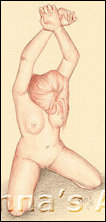 |
She kneels at the Master's feet and leans her body back, sitting upon her heels, with her arms extended upward, crossed at the wrists, and her head beneath them lowered in supplication |
| Combination Lock | A common lock found on Gor, but rather than numbers, letters are used. |
| combing circle | A group of kneeling slaves form a circle, each combing the hair of the one in front of her. Book 22: Dancer of Gor, page 112 |
| Commissary Wagon | The wagon in a camp of the Wagon Peoples where food is stored, prepared and served. |
| Common Chain / March Chain/ Trekking Chain | In reference to method of chaining slave girls for traveling |
| Companion Contract | The legal, binding contract between two free persons about to be betrothed. |
| Companion Journey | Usually performed for a high-caste betrothal, this is the procession of the bride-to-be to various cities and villages, to display the new bride, as well as the riches she brings. |
| Companionship Price/ Bride Price | the equivalent of a dowry for a Free Companion, though there is no legal marriage on Gor; If a man frees a slave, the slave's family is bound by honor to grant her to him without bride price. Book 1: Tarnsman of Gor, page 71 |
Compass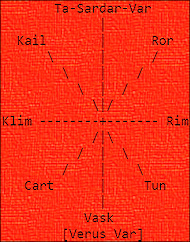 |
Similar to the compasses of Earth; as the Earth compass always faces to the north, the Gor compass always faces to the Sardar Mountains; divided into eight quadrants. |
| Complex Knot | Also known as the Signature Knot; each person has his or her own style of tying knots, used specifically for compartments that do not have a metal lock, but rather only have a latch string hole. These locks are complex designs of tying (or turns), i.e, Tarl Cabot had a 52-turn knot. Similar to the ancient Gordian knot, made infamous by Alexander the Great. |
| con | (conj.): from |
| contasta | 'from the founding of'; means of determining chronology; equivalent to the Earth term AD (Anno Domini) |
| Contasta Ar | Literal translation: "From the founding of Ar." This term is used for purposes of chronological time keeping, andcan be found in relation to the term, Ab urbe condita (related with Anno urbis conditae: AUC or a.u.c.) is Latin for "from the founding of the City (Rome)", traditionally set in 753 BC. It was used to identify the Roman year by a few Roman historians. Modern historians use it much more frequently than the Romans themselves did; the dominant method of identifying Roman years was to name the two consuls who held office that year. Before the advent of the modern critical edition of historical Roman works, AUC was indiscriminately added to them by earlier editors, making it appear more widely used than it actually was. The regnal year of the emperor was also used to identify years, especially in the Byzantine Empire after Justinian required its use in 537. |
| Contests of Oxen | The first of the two contests held in the Amusements of Tharna. |
| Contests of the Bola | A popular, though dangerous, game of the Wagon Peoples. |
| Contrition Dance | A placatory dance of Turia |
| Control Stick | Device used to control a slave girl. |
| Copper | Common ore found on Gor; used in the making of things such as bracelets. |
| Copper-Tarn-Disk-Girl | Bath girl whose price is a copper tarn. |
| Corcyrus | Located south of Tharna, known for its silver mines and slave trade. |
| Cord Collar | A collar made of rence cord; worn by slave girls of the rencers, a small disk denotes their owner. |
| Cords of Tharna | Rival paga tavern to the Chatka and Curla in Cos. |
| Cos | an island 400 pasangs west of Port Kar and hundred pasangs north of Tyros; notable for growing ta-grapes on it's terraced hills. The perpetual enemy of Ar. It's capitol city is Telnus. Other cities are Selnar, Temos and Jad. As the western border of known Gor, the waters beyond it are referred to as 'the World's End' by those who have first knowledge. To those Goreans with second knowledge, who are taught that Gor is spheroid, the expression is merely a figure of speech. Book 6: Raiders of Gor, pages, 139, 174, and 312 Book 12: Beasts of Gor, page 35 |
| Cosian Song Fish /Cosian Wing Fish | A type of fish that lives in the Thassa, part of their mating rituals brings them to the surface and they call to one another with strange lovely sounds. |
| Cosians | Street gangs are alive and well on Gor. This particular gang is found in Ar; they adorn Cosian garments and haircuts, causing much mischief. It is a Gorean belief that if one mimics what he fears, he will gain strength from it; thus during the war between Ar and Cos, this gang of street youths mimicked those of Cos in hopes the city of Ar would strengthen because of it. |
| Cosmeticians | One of the many sub-castes on Gor; not much is spoken of this caste. |
| Cotanka | In the language of the red savages, the term meaning "love flute." |
| Couching Laws | any Free woman who voluntarily 'couches' with the slave of another may be taken as slave herself by the Master of the slave she 'couched' with. Book 25: Magicians of Gor, page 7 and page 303 |
| Council Guard | The police force of Port Kar, formed after the failed coup of Henrius Sevarius to become the single Ubar of the city. |
| Council of Captains | A council of the city of Port Kar formed of the most powerful captains. The governing body of Port Kar, ranking below the Ubar |
| Coup | Coup literally means to strike an enemy at close range; effectively, to slap him. It is a game of honor amongst the red savages not to kill their enemy, but to see how close they can get to their enemy and "touch" him; often this "touching" includes the taking of scalps. The counting of coup places the warrior in the hierarchy of his tribe. Coup is counted by how close the warrior gets to his prey. For example, striking the enemy at close range with a bow and arrow might be considered in the range of a fifth to seventh coup, while touching the enemy with one's open hand would count as the highest coup ever, the first coup. The use of coup by John Norman suggests more the coup de main. |
| Courage Scar | Indigenous to the Wagon Peoples. This scar holds great social and economic status. |
Crater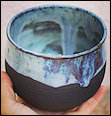 |
Drinking vessel for wine. |
| Crier | A sub-caste of the Caste of Scribes. The duties of the [town] crier is to announce special events, etc. |
| Cruelty | Also, it might be noted that most Gorean warfare is carried out largely by relatively small groups of professional soldiers, seldom more than a few thousand in the field at a given time, trained men, who have their own caste. Total warfare, with its arming of millions of men, and its broadcast slaughter of hundreds of populations, is Gorean neither in concept nor in practice. Goreans, often castigated for their cruelty, would find such monstrosities unthinkable. Cruelty on Gor, though it exists, is usually purposeful, as in attempting to bring, through discipline and privation, a young man to manhood, or in teaching a female that she is a slave. (pg. 145, Fighting Slave of Gor) |
| Cuneiform | In reference to Tarl's comments on how perhaps some of the letters of the Gorean alphabet derived, cuneiform refers to: "Wedge-shaped; Being a character or characters formed by the arrangement of small wedge-shaped elements and used in ancient Sumerian, Akkadian, Assyrian, Babylonian, and Persian writing; Relating to, composed in, or using such characters." - American Heritage College Dictionary, Third Edition ©2001 |
| Curiosity Is Not Becoming In A Kajira / CINBIAK | (acronym): a gentle warning often employed throughout the books. Book 7: Captive of Gor, page 14 Book 10: Tribesmen of Gor, page 315 Book 22: Dancer of Gor, pages 122, 151, 233, 277, and 290 Book 24: Vagabonds of Gor, page 44 |
| curla | the red waist cord worn slave- girls of the Wagon Peoples; supports the chatka |
| Cur-lon Fiber | fiber spun by the Swamp Spiders (Spider People) and used in the textile mills of Ar |
Curule Chair |
Ornately decorated chair usually reserved for dignitaries, magistrates, and other high officials. |
| Curulean | the most prestigious slave auction house in the city of Ar |
| Cuttlefish | One of any various squid-like mollusks. |
| cylinder | the primary architectural form of buildings in major Gorean cities; they are of varying heights and colors, flat-topped and cylindrical, connected by narrow, colorful bridges that arch between them. Book 1: Tarnsman of Gor, page 23 |
| Cylinder Lock | Common lock found on Gor; used for many purposes such as on doors, chests, and slave collars. |
| Cylinder of Documents | raries are separate from the Cylinder of Documents and are open to the public. |
| Cylinder of Justice | The judicial hall of Gorean cities; can either be civil courts or, if the Cylinder is white in color, the courts of the Initiates. |
| Cylinder of Warriors / Tower of Warriors | The building which houses warriors. |
| Cylix / Kylix | A footed, shallow drinking bowl of Grecian ancestry. |
| Cymbals | A percussion instrument which consists of a circular flat or concave metal plate that is used in pairs struck glancingly together. |
| czehar | musical instrument consisting of a flat, oblong box, having 8 strings which are played with a horn pick; similar to a Japanese koto |