Gorean Glossary H-J
Gor is a complex lifestyle based on a series of novels by John Norman featuring a strict caste system of highly trained Free and slaves. For more information, check out the Garden's section on Gor.
Note about this Glossary: items marked with a K are Kassar or Old Gorean, online-created languages used to augment Gorean. Kassar was not created or endorsed by John Norman and is not consistent within the Gorean language or universe. Kassar should be used cautiously and sparingly as many Goreans do not use or approve of the language.
| Hab | All (Things), Ever, Every |
| Haba Ka'an | always, forever |
| Hachka | home, Wagon-House, large wagon, "mobile home" |
| Hafti | (to) party, have fun |
haik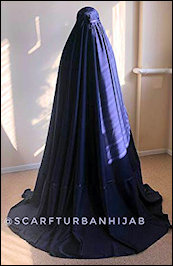 |
female garb worn in the Tahari. Black in color it covers the woman from head to toe. At the eyes, there is a tiny bit of black lace, through which she may see. Usually worn with soft black non-heeled slippers with curled toes. |
| Hail | greeting for Freepersons that is usually reserved for recognized experts or champions in a particular field, from sword fighting to game playing. Book 25: Magicians of Gor, page 52 |
Hair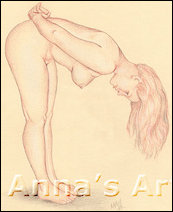 |
1. A command to a to kneel with her head down, offering the use of her hair for a variety of things, such as a leash or napkin. 2. A ponytail hairdo, also known as the "Leash" and is often favored by masters because a girl may be seized and controlled by it. 3. She stands, her feet flat on the floor, and bows gracefully at the waist, that her hair might fall forward for display, or to be shorn, seized, or used for any purpose that the Master desires. |
| Hak/Haka'an | Alone, Only, Just |
| Hall of Commissaries | Store in the Nest of the Priest-Kings where Muls and Matoks are issued tunics, etc. |
| Hall of Council | The meeting room of the Council of the Captains in Port Kar. |
| Hall of Processing | Because of the fastidiousness for cleanliness of the Priest-Kings, this room is where any within or before entering the Nest, are cleansed of any contamination, both externally and internally. |
| Hammerfest | One of the Vosk River townships. |
| hand | 1. The Gorean week, consisting of five (5) days. 2. A unit of measurement specific to animals, such as kailiauk, kaiila and bosk, from the ground to the top of the shoulders. 3. Highly militaristic and organized, with divisors and multiples having to do with seemingly, a base-twelve mathematics, a Hand is a Kurii military unit formed of six (6) lowest ranked Bloods; their leader is called an Eye. |
| hand signs / hand talk / sign language | Sign language of the red savages. A mode of communication common to all the tribes of the Barren, sign is simple, easy to learn and adequate for relaying information. Book 17: Savages of Gor, pages 242-249, 257 and 263 |
| Handle Tie | A method of binding a slave girl or captive female. |
| Hanging | An ancient form of execution in which the offenders are chained and suspended by iron collars on posts, taking two to three days to die. |
| harbor side | sailors of Cos refer to the left side of the ship by the port of destination and the right side of the ship by the port of registration. When the ports of destination and registration are the same, then the left side of the ship is called the 'harbor side', while the right side continues to be designated as before, by the port of registration. The expressions 'port' and 'starboard' do not exist in Gorean language. Book 11: Slave Girl of Gor, page 362 |
| Harfax | One of the major cities of slave trade. |
| Harigga | Literal meaning is "Bosk Wagons;" not an actual city. |
| Harl Loop | A form of chaining slaves with harl rings |
| Harl ring | a form of slave chain which consists of an ankle ring with a welded ring in back and a yard of in front; the chains termi- nates in a locking device which can be attached to another Harl ring, around a post, or to itself in order the secure the slave who wears it; named for its inventor |
| Harness | Usually of leather, used for the binding of a slave or captive. |
| Harpoon | Throwing weapon of the Innuit. |
| Harrow | 1. An agricultural tool used primarily to level the ground after plowing, smoothing the soil, mulching and covering seed. 2. Named for the agricultural tool which resembles a large rake, this tactic was developed by Dietrich of Tarnburg and is most effective against tharlarion cavalries. In this formation, spikes of archers, protected by iron-shod stakes and sleen pits, project beyond the forward lines of heavily armed warriors and their reserves. |
| har-ta! | faster! |
| haruspex | A diviner. Not a soothsayer. At times John Norman uses them interchangeably, however, one quote he does speak of them as two separate things; omen-taker |
| Havasi | Bend, Be Flexible, Springy |
| Hci | The term used to describe a type of gap which might occur in the edge of a trade ax, or hatchet (used to draw nails free), or a gash as in a cut in a tree, or a scar. |
| Heat | a slave's vagina and her desperation to serve her Master sexually. |
| Heavy Class | Denotes the size of a ship; most ram-ships are of medium or heavy class. |
| Heiban | One of the four original towns that latter combined to form the city of Tetrapoli. |
| Helmsman | Just as on earth, a nautical term to denote the one whose job it is to tend the tiller of a boat, thus steering it; the steersman. |
| Helmutsport | One of the coastal free port cities of Gor. |
| Hemaca | A red savage term meaning "I am." |
| Hemp | Hemp is mentioned only briefly in the books, with no detail that this hemp differs to the hemp plant of earth. I've seen sites try to use the quote from the books to justify marijuana use as part of Gorean role play. In the quote, reference to the hemp is clearly the Bowstring Hemp and not the cannabis these other sites are intimating. |
| Herd of Tancred | A gigantic herd of tabuk in the far north, of which annually makes the same migratory trek. This herd is vital to the lives of the Red Hunters of the Gorean arctic. |
| Herd Sleen | Trained prairie sleen used by the Wagon Peoples as sentinels and shepherds. |
| herlit | Gorean eagle, having a wingspan of 6-8 feet; is carnivorous, and has yellow feathers tipped with black; also called 'Sun-Striker' or 'out-of-the-sun-it-strikes', from its habit of striking with the sun above and behind it; inhabits the Barrens |
| Herlit-Bone Whistle | Made of the bones of the Herlit, this whistle is used by the Kaiila tribe in the performance of the Great Danceas well as in strategic instructions during raids. |
| Hermit Bird | A variety of forest-dwelling bird; a woodpecker. |
| Hersius | the planet Jupiter; named for a legendary hero of Ar |
| Hesa | Blood, Friend |
| Hesius | A hero of legends who is believed to be the first to deliver to the people of Gor, the first Home Stone. |
| Hig | Beard |
| High Castes | Most Gorean societies are built on the Caste system. The High Castes are considered the intellectuals. |
| High Initiate | The highest seat in the Caste of Initiates. |
| High-Harness Position | A display position of slaves. |
| Hinrabian Kilns | Kilns owned by the Hinrabian family, of the Caste of Builders, which produced much of the brick in Ar. |
| hinti / hala | small, flea-like insects; unlike fleas, they are not parasites |
| hith | huge python-like snake |
| Ho /howe / hou | 1. A common prefix indicating lineage Book 24: Vagabonds of Gor, page 343 2. The term in the red savages language meaning "yes." |
| hobble, slave | The slave hobble consists of two rings, one for a wrist, the other for an ankle, joined by about seven inches of chain. In a right-handed girl, it locks on the right wrist and left ankle. When the girl kneels, in any of the traditional positions of the Gorean woman, either slave or free, it is not uncomfortable. (Nomads of Gor, book iv, page 155) |
| Hodakiciyapi | The term in the red savages language meaning "peace and friendship." |
| Hogar Variation of the Centian | A Kaissa move. |
| Hogarthe Tree | A tree found in the Barrens named for one of the early explorers of the area. |
| Hohg | Another (One), More |
| Hok/Hoki | Argument / debate |
| Hokmari/Hokmaris | Ambush |
| Holding Cell | Cells used at auction houses for the keeping of slaves that are being sold. |
| homan | a letter of the Gorean alphabet; derived from the Cretan alphabet |
| Home Stone | 1) a stone, often circular and flat, that is sacred to each dwelling, and is to be defended ferociously by even the meanest peasant; 2) a similar stone that represents the soul of a city; to be without a Home Stone is to lack citizenship. "Gor is the name of this world. In all the languages of this planet, the word means Home Stone. In peasant villages on this world, each hut was originally built around a flat stone which was placed in the center of the circular dwelling. It was carved with the family sign and was called the Home Stone. It was, so to speak, a symbol of sovereignty, or territory, and each peasant, in his own hut, was a sovereign. Later, Home Stones were used for villages, and later still for cities. The Home Stone of a village was always placed in the market; in a city, on top of the highest tower. The Home Stone came naturally, in time, to acquire a mystique, and something of the same hot, sweet emotions of our native peoples of Earth feel toward their flags became invested in it." "Where a man sets his Home Stone, he claims, by law, that land for himself. Good land is protected only by the swords of the strongest owners in the vicinity.// Yet there is a hierarchy of Home Stones, one might say, and two soldiers who would cut one another down with their steel blades for an acre of fertile ground will fight side by side to the death for the Home Stone of their village or of the city within whose ambit their village lies. (As explained by the Father of Tarl Cabot, in Tarnsman of Gor, book I, page 26-27) Indeed, there is a saying on Gor, a saying whose origin is lost in the past of this strange planet, that one who speaks of Home Stones should stand, for matters of honor are involved, and honor is respected in the barbaric codes of Gor. (A comment by Tarl Cabot, Tarnsman of Gor, Book I, page 27.) "Describe to me," said he, "the Homestone of Ar." She looked down, confused. She could not do so. Young men and women of the city, when coming of age, participate in a ceremony which involves the swearing of oaths, and the sharing of bread, fire and salt. In this ceremony the Home Stone of the city is held by each young person and kissed. Only then are the laurel wreath and the mantle of citizenship conferred. This is a moment no young person of Ar forgets. The youths of Earth have no Home Stone. Citizenship, interestingly, in most Gorean cities is conferred only upon the coming of age, and only after certain examinations are passed. Further, the youth of Gor, in most cities, must be vouched for by citizens of that city, not related in blood to him, and be questioned before a committee of citizens , intent upon determining his worthiness or lack thereof to take the Home Stone of the city as his own. Citizenship in most Gorean communities is not something accrued in accident of birth but earned by virtue of intent and application. The sharing of a Home Stone is no light thing in a Gorean city. (Slave Girl of Gor -- page 394) 3. A Kaissa piece. |
| Hon/Hona | Book |
| Honey | Delicious product of the honey bee. |
| Honey Bees | These industrious insects make delicious honey. |
| honor | " I do not understand them," she said. "To uphold the law they have jeopardized their careers, they have entered into exile!" "There are such men, "I said. "I do not understand them, "she said. "That,' I said, `is because you do not understand honor." (pg.478, Magicians of Gor) "You risked so much for a mere point of honor?" she asked. "There are no mere points of honor,' I told her." (I)(pg.63, Vagabonds of Gor) "I had for an Ahn at that place recollected my honor. Let that be commemorated by the flames." (pg.320, Hunters of Gor( "`How many men do you have?' I asked. `Fifty-five,' he said. `I was not always of the merchants,' I told him. `I do not understand,' said Sarus. `Once,' I said, `long ago, I was of the Warriors.' `There are fifty-five of us,' said Sarus. `My city,' I said, `was the city of Ko-ro-ba. It is sometimes called the Towers of the Morning.' `Surrender,' whispered Sarus. `Long ago,' I said, `I dishonored my caste, my Home Stone, my blade. Long ago, I fell from the warriors. Long ago, I lost my honor.' Sarus slowly drew his blade, as did those behind him. `But once,' I said, `I was of the city of Ko-ro-ba. That must not be forgotten. That cannot be taken from me.' `He is mad,' said one of the men of Tyros. `Yes,' I said, `once long ago, in the delta of the Vosk, I lost my honor. I know that never can I find it again. That honor, which was to me my most precious possession, was lost. It is gone, and gone forever. It is like a tarn with wings of gold, that sits but once upon a warrior's helm, and when it departs, it returns no more. It is gone, and gone forever.' I looked at them, and looked, too, upward at the stars of the Gorean night. They were beautiful, like points of fire, marking the camps of the armies of the night. `Yes,' I said, again regarding the men of Tyros, `I have lost my honor, but you must not understand by that that I have forgotten it. On some nights, on such a night as this, sometimes, I recollect it.' `We are fifty-five men!' screamed Sarus... He turned to face me, wildly. He saw that my blade was now drawn. `You are not of Ar!' he cried. `It would be better for you,' said I, `if I were.'" (pg.275-276 Hunters of Gor) "If it turned out badly, what I did, I would have no defense other than I did what I did for my friend for him-and for his brave kind, once hated enemies, whom I had now learned to know and respect. There is no loss of honor in failing to achieve such a task, I told myself. It is worthy of a warrior of the caste of Warriors, a swordsman of the high city of Ko-ro-ba, the Towers of the Morning." (pg. 8, Nomads of Gor) |
| Hook Bracelets | A variation of the steel shackles, hook bracelets are soft leather cuffs with both locks and snaps on them. The snaps require no key and allow for the girl to be secured in various manners, such as her hands behind or before her, or to her collar. |
| Hook Knife | A small hook-shaped knife. It is also for the name of the sport in which slave combatants use sheathed hook knives. |
| Hook-Beak Turtle | A carnivorous turtle of the Vosk. |
| hook-billed gort | a carnivorous hunting bird of the rainforests inland of Schendi; preys on ground urts |
| hopa | red savage term meaning pretty or attractive. Book 17: Savages of Gor, page 216 |
| Horn Bow / Small Bow | Bow favored by the Tuchuks. |
Horn Spoon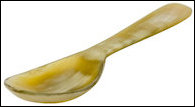 |
An eating utensil made of the horn of an animal, most probably the bosh. Based upon descriptions of what is eaten with this spoon, it is probably large like a soup spoon of Earth. |
| Horned Gim | A tiny owl-like bird. |
| Horned Tharlarion | One of the many breeds of the thunder lizards. |
| Horned Verr | A mountain goat which has a spiral horn; NOT a kangaroo-like animal as I have seen described on other sites. |
| Horse | In the world of Gor, the horse is a mythological beast, depicted on cave walls found by Tarl Cabot in Torvaldsberg. |
| hort | measurement. 1.25 inches |
| hou | a form of greeting for Red Savages. Book 17: Savages of Gor, page 240 |
| house marshal | a position within a free woman's home responsible for security and/or travel. Book 25: Magicians of Gor, page 13 |
| House of Cernus | One of the largest slave houses located in Ar. |
| House of Clark | Large slave house. |
| house veil | the next-to-last veil worn by free women, esp. when in the company of men not of her own family; worn over the pride veil, and under the street veil upon leaving the house |
| Howo | In the language of the red savages, the term eaning "come" (possibly "heel"?). |
| huda | a unit of measure equaling 5 tefa |
| Hulneth | One of the exchange islands located in the northern portion of Gor. |
| Hunjer | One of the exchange islands located in the far northern portion of Gor. |
| Hunjer Long Whale | Rare whales that live in the arctic north. |
| Hunjer Whale | One of the toothed whales that live in the arctic north; most likely the Orca of Gor. From this quote, it's not certain that the Long Hunjer Whale and the Hunjer Whale referenced here are one and the same. |
| Hunter's Catch | A special costume, with the use of netting, of slave girls generally worn when entertaining important guests. |
| Hunting Arrow | A simple-pile arrow favored for hunting, as it is designed to pull the arrowhead free of the victim. The shafts are either sheaf (short bow) or flight (long bow). |
| hurt | a kangaroo-like animal whose wool is used for cloth |
| Hurt Ranches | Where hurts are raised for their wool. |
| Hydria | the hydria is a two-handled vessel used for serving water. The hydria dates back to the ancient |
| I ask your favor | Gorean phrase equivalent to 'Please' |
| I wish you well | Gorean phrase of farewell |
| Ianda | One of the exchange islands located in the southern portion of Gor. |
| Ice Beast | A white-furred Kur. |
| ice house | a place Goreans can go to purchase ice during the summer, although most Goreans cannot afford this luxury; the ice cut from ponds in the winter and is stored under saw dust until use. Book 16: Guardsman of Gor, page 295 |
| Ice Mountain | Gorean expression for an iceberg. |
| Ice Wagon | Wagons specifically built to delivery ice to those wealthy Goreans who can afford ice during the summer . |
| Identificatory Anklet | In lieu of a collar, a small metal anklet is fastened about a captured Earth girl's ankle for transportation to Gor; it is removed once she is delivered on Gor |
| Identificatory Slave Bracelet | In lieu of a collar, a small metal bracelet is placed around the wrist of a slave; generally used by owners of lure slaves. |
| Igloo / Iglu | Innuit shelter; not necessarily made from snow or ice. |
| Ihanke | In the language of the red savages, a word meaning "Boundary." |
| Ihdazicaka | The term which means One Who Counts Himself Rich in the language of the red savages. |
| Ihn | Gorean second, 80 in an ehn |
| Ijuki | (to) like, prefer |
| Ik | After, Beyond, Passed |
| Ikdi | Too Much, The Most |
| Ikseek | Beyond Number, Beyond Counting |
| Il Durma | last night |
| Immunity of the Herald | Another phrase for that old adage, "Don't shoot me, I'm just the messenger." |
| Imnak | Masculine Innuit name which means "Steep Mountain." |
| I'mota | Brother |
| Impalement | A form of execution in which the person is laid over the point of a pole to slowly die. |
| Implanted One | The Priest-Kings were a suspicious, wary lot. Therefore, they often implanted a person to act as their agent, or spy, upon other Goreans. After the Nest Wars, Misk recalled the use. |
| ina | a letter of the Gorean alphabet |
| Inboard Oar | The inboard oar is the longest oar. |
| Initiates Caste | representatives of the Priest Kings. The caste color is white. One of the High Castes |
| Initiatory whipping | ritual first whipping of ten strokes from a slave's new owner as a reminder of her place |
| Initiates, Caste of | the representatives of the Priest-Kings in Gorean society; the Initiates are one of the five High Castes, and are the religious branch of the government; their caste color is white |
| Inland Language | The "inland language" is actually a compilation of many dialects spoken in the Ushindi region. |
| Innuit | The Red Hunters; a nomadic group of people that live in the arctic north. Literally "The People" in the language of the Red Hunters; what the Red Hunters call themselves. |
| Innuit Carving Knife | Knife used by the Innuit in their carvings of ivory and bone; long wooden handle, short point for easy guidance by fingers. |
| Innuit Drums | Large heavy drums, disk-like and with a handle. Much strength is needed to manage these drums which are held in one hand and beaten with a stick held in the other hand. |
| insula | a crowded, cramped tenement type dwelling, which rents living space to it's inhabitants. They are not noted for their ventilation, luxury, or roominess. Book 21: Mercenaries of Gor, pages 273-275 Book 25: Magicians of Gor, pages 9 and 102 |
| intimacy veil | a long, linear, diaphanous face veil worn by Free woman. It's opacity is determined by how many times it is wrapped about the face. Book 12: Beasts of Gor, page 404 |
| Invisibility Rings | Rings designed by the great Kurii scientist, Prasdak, which project a light diversion field, thus enabling its wearer to become invisible to the normal visual range spectrum; also called Light Diversion Rings. |
| iron belt | commonly consisting of a horizontal metal bar or strap that snugly encircles a girl's waist with a vertical component attached to the front of this horizontal bar with a hinge. The vertical component is then swung up between a slave's legs and all are fastened at the small of the back with a padlock. Locked around a girl, it ensures that she will not be sexually used by any, save the one with the key. Book 19: Kajira of Gor, page 103 Book 22: Dancer of Gor, page 299 Book 25: Magicians of Gor, pages 57 and 293 |
| Iron Hooks / Spurs | Similar to the iron hooks of ancient Earth, sometimes referred to as "spurs," these metal spikes are set into wooden blocks and buried in the sand, used as a military defense. |
| Iron Master | one who is skilled at piercing ears and noses, branding, and affixing collars to slaves. Book 4: Nomads of Gor, page 173 |
| iron pens | slave pens in a Slaver's house |
| Isanna | The term in the Kaiila dialect of the red savages meaning "little knife." |
| Isanna Band | Little-Knife Band. One of the five bands (subgroups) that make up the red savage Kaiila tribe. The origin of the name perhaps arose from a Dream, which are important to the red savages. They inhabit the areas around Council Rock, north of the northern fork of the Kaiila River and west of the Snake River, a tributary to the Northern Kaiila River. The proper way to refer to them would be Isanna Kaiia. The Isanna number approximately seven- to eight-hundred (700-800) members. |
| Isbu | The term in the Kaiila dialect of the red savages meaning "little stones." |
| Isbu Band | a sub-group of the All Comrades |
| Ish/Isha | Doctor |
| Ishan/Ishana | Chicken |
| Iskander | One of the river townships along the Vosk River. |
| Istawicayazanwi | In the language of the red savages, term meaning the Sore-Eye Moon; one of the winter moons. |
| Itancanka; Wicayuhe | Kaiila and Dust Leg word meaning Master. Book 17: Savages of Gor, page 23 |
| Iv | Also, Even |
| Iwoso | The term in the red savages language meaning pouting lips. |
| Ja | My |
| Jachi | (to be) honored, paid homage to, worshiped |
| Jad | One of the four major cities on the island of Cos. |
| ja'heas | blood sister |
| jahesa | island |
| Ja'hesa | My Friend- blood sister |
| Jai | May |
| Jai a keh'ra greshak tahem jula | May you fly upon wings of glory |
| Jai na ven sev a lae an she'vo a porte | May your day bring happiness and joy to you and yours |
| jal | this |
| Ja'lina | My heart |
| Ja'lina dan'le di kar, Tre'sha | My heart beats with Love, precious |
| Ja'lina tran kirou | My heart is open to thee. |
| Ja'lina, a she arquana nadru jesku jula jan | My Heart, you are worth all of the skies |
| Jama | Mine |
| Jan | The |
| Jan | Travel |
| Jan di ashe drena kanta vethuk lina | Travel with an open mind and heart |
| Ja'ni tran dela | My clan welcomes thee. |
| Ja'ni tran dela. Ja'lina tran kirou. Shivar | My clan welcomes thee. My heart is open to thee. Peace be between us |
| jard | a small, yellow-winged scavenger bird of the rainforest inland of Schendi |
| Jareem/Jareema | Brown |
| Jarl | the leader of warriors in Torvaldsland, the title used for all Free Men by bondmaids |
| Jasaqi | Make Clothing |
| Jasee /Jasee | Clothing |
| Jashi | Thanks, Thank You |
| Jashi Avan'she | Thank You Mistress |
| jashi i'mota | thank you brother |
| jashi jerag | thank you sister |
| jashi va | thank you |
| Jashi Vana'she | Thank You Master |
| Jasi | Clothe yourself or someone else, (To) Wear Clothing. |
| Jasmine | One of the Vosk River townships. |
| Javelin | A throwing weapon. |
| Jerag | Sister |
| Jer'amij | Grin |
| Jerq/Jerqa | Berry |
| Jesku | Worth |
| Jesuil | Beauty |
| Jeweled Ankle Ring, The | A paga tavern located in Ar. |
| Jimeleri | become wise, enlightened, chosen |
jit monkey/ tarsier |
a simian mammal which inhabits the rainforests inland of Schendi |
| Jort's Ferry | One of the Vosk River townships. |
| Judge's Bar | Device used by the judge at a tarn race to signal particular events; probably much like an alarm bar in construction as it must be able to be heard by all at the stadium. |
| Judicial Enslavement | Enslavement of a free person who has committed some criminal act, such as thievery. |
| Jula | Glorious/Glory |
| Jungle Gant | A bird of the Schendi; of the Gant family. |
| Jungle Panther | A feline predator of the jungles of the Ushindi. |
| Jungle Vart | A relative of the northern vart, and inhabits the rainforests inland of Schendi. |
| Jungle Zad | A scavenger bird of the rainforests of the Ushindi. |