Gorean Glossary K-L
Gor is a complex lifestyle based on a series of novels by John Norman featuring a strict caste system of highly trained Free and slaves. For more information, check out the Garden's section on Gor.
Note about this Glossary: items marked with a K are Kassar or Old Gorean, online-created languages used to augment Gorean. Kassar was not created or endorsed by John Norman and is not consistent within the Gorean language or universe. Kassar should be used cautiously and sparingly as many Goreans do not use or approve of the language.
| Ka | perfect | K |
| Kadluk | Masculine Innuit name which means "Thunder." | |
kaffiyeh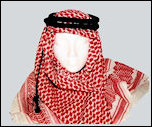 |
desert garb. A small squarish scarf folded over into a triangle, placed over the head, 2 points at the side of the shoulders, one in back to protect the neck. It is bound to the head by several loops of cord called an Agal. The color of the cording indicates his tribe and district. | |
| Kaftan | A silken lounging robe worn by free men of the Tahari. | |
| Kahintokapa | In the dialect of the Kaiila tribe of the red savages, this term means "One-Who-Walks-Before ". | |
kaiila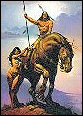 |
It is a silken, carnivorous, lofty creature, graceful, long-necked, smooth-gaited. It is viviparous and undoubtedly mammalian, though there is no suckling of the young. The young are born vicious and by instinct, as soon as they can struggle to their feet, they hunt. it is an instinct of the mother, sensing the birth, to deliver the young animal in the vicinity of game. I supposed, with the domesticated kaiila, a bound verr or a prisoner might be cast to the newborn animal. The kaiila, once it eats its fill, does not touch food for several days. The kaiila is extremely agile, and can easily outmaneuver the slower, more ponderous high tharlarion. It requires less food, of course, than the tarn. A kaiila, which normally stands about twenty to twenty-two hands at the shoulder, can cover as much as six hundred pasangs in a single day's riding. The head of the kaiila bears two large eyes, one on each side, but these eyes are triply lidded, probably an adaptation to the environment which occasionally is wracked by severe storms of wind and dust; the adaptation, actually a transparent third lid, permits the animal to move as it wishes under conditions that force other prairie animals to back into the wind or, like the sleen, to burrow under the ground. The kaiila is most dangerous under such conditions, and, as if it knew this, often uses such times for its hunt. (Nomads of Gor, book iv, page 13) (More information picked up in the same book) It has a triangular tongue. Its mouth contains four rows of fangs. It seems to come in the solid colors similar to urth animals called horses. Its claws are retractable to an extent allowing it to stop quite suddenly. They squeal, snarl and hiss, even scream in rage. They have long silken hair ofttimes used to braid rope. Tuchuk kaiila are trained to avoid the thrown spear. It is a training which begins with blunt staves and progresses through headed weapons. Until the kaiila is suitably proficient in this art is it not allowed to breed. Those who cannot learn it die under the spear. The milk is used by the peoples of the Tahari as verr milk is used elsewhere, it is reddish with a salty strong taste due to the content of ferrous sulfate. Book 10: Tribesmen of Gor, page 71 |
|
| Kaiila / Cutthroat Tribe | a tribe of Red Savages which inhabits the Barrens; their language is related to that of the Dust Legs | |
| Kaiila Boots | Due to the roughness of the ride, as with the cowboys of Earth, the riders of kaiila also suit up to protect their bodies; one such necessity included leather boots. | |
| Kaiila Bridle | Apparently there were bridles used with the kaiila. | |
| Kaiila Crop / Kaiila Quirt | A whip made from the hide of a kaiila. | |
| Kaiila Goad | Akin to the spurs on the boots of cowboys on Earth, kaiila riders wear a leather boot with heel points known as kaiila goads. These are used as a means of controlling the beasts. | |
| Kaiila Harness | Not much is mentioned about the kaiila harness, except this small quote about that of the Tahari region, where customarily bells are worn on the kaiila harness as a means to display friendly intentions. | |
| Kaiila Ranches | Where the kaiila are bred and trained. | |
| Kaiila Reins | The rein is a light single rein which is many-plaited, and drawn through a drilled hole in the right nostril of the kaiila. | |
| Kaiila River | Large river of the Barrens, it eventually branches off and becomes two rivers, known as the Northern Kaiila and Southern Kaiila; though simplicity allows for referring to them all as the Kaiila River or Rivers. | |
Kaiila Rope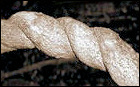 |
A weapon of the Wagon Peoples made of the hairs of the kaiila. | |
| Kaiila Saddle | The saddle of the kaiila is usually of leather, and made similar to that of a tarn saddle so as to accommodate having a bound female captive across it. | |
| Kail | Gorean map direction | |
| Kailiauk | 1. ...lumbering herd of startled, short-trunked, kailiauk, a stocky, awkward ruminant of the plains, tawny, wild, heavy, their haunches marked in red and brown bars, their wide heads rustling with a trident of horns; they had not stood and formed their circle, shes and young within the circle of tridents; they, too had fled... (Nomads of Gor, book iv, page 2) 2. Large trading settlement located on the boundary of the Barrens. | |
| Kailiauk [Tribe] | One of the tribes of the red savages; not much is mentioned of this tribe; the hand signal for this tribe is holding up three fingers to represent the three-horned beast they are named after. | |
| Kailiauk Horn | Useful tool made from the horn of the mastodon. | |
| Kailiauk, The | A paga tavern in Port Kar. | |
| Kaissa | a boardgame much favored on Gor; the board is marked with 100 squares, colored alternately red and yellow; there are 20 pieces per side, which represent Ubar and Ubara, Initiates, Riders of the High Tharlarion, Tarnsmen, Scribes, Builders, Spearmen or Spear Slaves, and the Home Stone; it is played much like chess, the object being to capture one's opponent's Home Stone; in Torvaldsland, the Ubar, Ubara, tarnsman, Initiate, and Scribes are replaced by the Jarl, Jarl's Woman, Ax, Rune-Priest, and Singer, respectively | |
| Kaissa Ciphers | Utilized mostly by the Caste of Players, though they can be used by anyone, a series of codes for the transmission of private messages; often extremely difficult to decipher. | |
| Kaissa of En'Kara / Merchant Kaissa | The standardized version of Kaissa developed by the caste of Merchants in conjunction with the caste of Players was officially decreed for the first time at one of the fairs of En'Kara in 10,124 C.A. ("Contasta Ar"); also spoken of as Merchant Kaissa. | |
| kajira mira | My slave. | |
| Kajira Talmit | A headband made of brown rep-cloth, worn by the first girl of work slaves in order to be recognized as first girl. In slaver houses or compounds, the slave trainer wears a Kajira Talmit of silk, to indicate she is first girl and trainer. | |
| kajira/ kajirae/ kajirii | Perhaps the most common expression for a female slave. (Nomads of Gor, book iv, page 30) | |
| kajirus/kajiri | a male slave | |
| Kajuralia | In virtual Gor, I have seen Kajuralia celebrated in that the frees and the slaves trade "roles;" that is the free become slaves, and the slaves become frees. This is another example of incorrect information found in many Gorean chat sites. The "Holiday of Slaves," or "Festival of Slaves" as it is also known, is a festival in which slaves have much freedom to play tricks on free persons; there was an occasion cited in the books in which a couple of free men became "slaves" to their female captors, and it was not a given that frees and slaves exchanged roles. The festival is celebrated in most cities on the last day of the Twelfth Passage Hand, but in Ar and many other cities, it is celebrated on the last day of the fifth month, which is the day before the Love Feast. Port Kar does not participate in Kajuralia. | |
| Kakidlamerk | Feminine Innuit name which means "Thistle." | |
| Ka-la-na Tree | A yellow-wooded fruit-bearing tree. The fruit is not only eaten, but is used in making Ka-la-na wine; the wood is used in making weapons such as the long bow. | |
| Ka-la-na Wine | Made from the fruit of the Ka-la-na tree, this wine is a sweet and dry wine, red color, light in hue and incandescent. It is also known as the drink of romance, served as a toast of Free Companionship. | |
| Kalb/Kalba | Dog. Dogs do not exist on Gor. | K |
| kal-da | beverage made from ka- la-na wine diluted with citrus juices and mixed with strong spices, and served hot; favored by laborers | |
| Kal-da Shop | A low class establishment similar to a Paga Tavern | |
| kalika | musical instrument having a long neck and hemispheric soundbox, its 6 strings being plucked; similar to a banjo | |
| kalmak | vest of black leather worn by the slavegirls of the Wagon Peoples | |
| Kaluva | Chair, Throne | K |
| Kamba | 1. An inland (Schendi) word which means "Rope." 2. River which is fed by Lake Ushindi and empties directly into Thassa. | |
| Kampi | (to) say, tell, speak, make words, meaningful sounds | K |
| Kan | Body | K |
| Kanalee | Body Signs, Auras, Brain Waves | K |
| kanda | A desert shrub; the leaf is often chewed for its narcotic value as a painkiller, and the root, when ground and boiled makes an extremely deadly poison. | |
| Kanda | chewing gum | K |
| Kanda, Kandoo | poison, drug (Kan:body +Doo:sword leads to the Gorean word, Kanda) however, the common Kanda leaves have a pain-killing effect and are sometimes chewed to ease body aches. The big problem is that kanda is habit-forming and slowly kills. | K |
| Kang/Kanga | Bird(s) | K |
| kan-lara | "slave brand" | |
| Kanta | Mind | K |
| Kantasawi | In the language of the red savages, term meaning the moons in which the plums are red; one of the spring moons. | |
| Kantharos | The footed bowl used for serving Paga. | |
| Kapisti | Allow, Permit, Give Permission | K |
| Kar | Love | K |
| kara | Turning, as in time (month). | |
| Kari | Be, Is, Am, Are | K |
| Kari e yara laybis | That girl is a bitch | K |
| Kari Pasu | I'm fine | K |
| Karian Anchor Knot / Anchor Knot | One of the many simple, common Gorean knots. | |
| Karjuk | Masculine Innuit name which means "Arrow." | |
| Karl Whale | One of the baleen-type whales that inhabit the arctic north. | |
| Karpar/Karpara | Bracelet, Wrist Metal | K |
Karta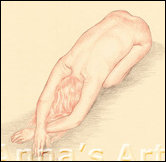 |
Making a form of obesience before entering a room. The slave kneels in nadu, and presses her breasts and forehead to the floor, arms outstretched. | K |
| Kasbah | Fortresses of the desert tribes in the Tahari. | |
| Kashani | a minor tribe of the Tahari; they are a vassal tribe of the Kavars | |
| kaska | a small hand drum | |
| Kasra | Tahari Desert city famous for exporting red salt. | |
| Kassar | A language created by online users to augment Gorean. To be used with caution. | K |
Kassar |
one of the 4 tribes of the Wagon Peoples; also called the Blood People; their standard is a scarlet bola. Brand shown. | |
| Kassau | A town located at the edge of the forests in the north, it is the seat of the Highs Initiate of the north, who claim spiritual sovereignty over Torvaldsland. | |
| Kat/Kata | Cat | K |
Kataii |
one of the 4 tribes of the Wagon Peoples, whose members generally have darker skin than most Goreans; their standard is a yellow bow. Brand shown. | |
| Katch | A foliated leaf vegetable; similar to a lettuce or cabbage. | |
| Kavars | a major tribe of the Tahari; their vassal tribes are the Ta'Kara, Bakahs, Char, and Kashani; their war-cry is 'Kavars Supreme!' | |
| Kavi | (to) choke | K |
| Kayak | Light one-man boat made of the skins of sea sleen normally; used by the Innuit. | |
| ke dela bazj | welcome back | K |
| Keamnoic | Walker | K |
| Kean | TRUE | K |
| Keep | Just as on earth, it is the same on Gor, a "Keep" is a stronghold, designed for defense. | |
| Keepers of Tradition | Historians of the Priest-Kings, they ensure that standardization is maintained. | |
kef |
Gorean letter "K". The first letter of "kajira". A typical slave brand | |
| Keh'ra | Fly | K |
| Kekana | Peasant | K |
| Keleustes/ Hortator / Time Beater | a member of a Gorean galley who beats out the rowing time with leather covered wooden mallets on a copper covered drum. His wrists are usually wrapped in leather and is normally a very strong man. | |
| kennel | A slave confinement; generally a small cement cell, customarily three feet by four feet (3' X 4'), with an iron gate which can be raised and lowered. In a slaver's house, there can be many such kennels bolted together and tiered, anchored to a wall. Slave cages are often mistakenly called "kennels" but as evidenced in the following quotes, they are two different forms of confinement. A kennel is a permanent type cell, whereas a cage is temporary. | |
| kes | short tunic of black leather worn by the male slaves of the Wagon Peoples | |
| kes shrub | a shrub whose leaves are used to make sullage | |
| kettle and mat slave | a slave who cooks, cleans and may also warm Master's furs. | |
| Kettle Slave | Kitchen slave; serving slave. | |
| Key Box | A small, heavy metal holding box for keys in prisoner cell blocks. | |
| ki | "no" or a negative | |
| killing knife | described as a throwing knife like those used in Ar, smaller than the quiva, a kanda paste is applied to the tip of the blade. An assassin's weapon. Book 5: Assassin of Gor, pages 41-42 | |
| Kimaco | War | K |
| Kinyanpi | A term in the language of the red savages meaning "Flighted Ones." This term is in reference to white tarnsmen. | |
| Kirou | Own | K |
| Kirtle | The livery of the slave girl of Torvaldsland; a thin white woolen garment, which hangs to the ankles, sleeveless with a plunging neckline. | |
| Kiss of the Master | A violent kiss to prove a master's dominance over his slave. | |
| Kiss of the Mistress | Just as a master will give a new slave a violent kiss as proof of his dominance over her, and to remind her that she is owned, a free woman taking a male slave may also do the same, usually at the time of the taking of a male slave. | |
| Kiss of the Whip | Literally, the whipping of a slave with a slave whip. | |
| Kitchen Master | The free male in charge of the kitchens of a home, Slaver's House, etc. | |
| Kite | Bird of the plains. | |
| Ki-Var | A map direction Ta-Sardar-Ki-Var "not turning toward the Sardar Mountains [north]" or south | |
| Klang/Klanga | Bell, Gong | K |
| Klim | Gorean map direction. | |
| Knee Crawl/ knee walk | a slave travels on knee's, without standing, to fetch items or tend to duties. Book 25: Magicians of Gor, page 342 | |
| Kneel to be Coffled | The command given to slave girls to line up in proper form to be coffled. | |
| Kneel to the Whip / Whipping Position |
this command orders a slave to kneel, bowing her head to her knees, her wrists crossed under her as though bound. The position is intended to expose her back to the whip. Book 3: Priest-Kings of Gor, page 201 and 202 Book 7: Captive of Gor, page 200 Book 15: Rogue of Gor, page 21 Book 18: Savages of Gor, page 137 | |
| knife brand | rather like a tattoo, an appropriate design is cut into the thigh of a slave and a colored powder is rubbed into it. Book 13: Explorers of Gor, page 330 | |
| Knife Lock | A booby-trapped lock. | |
| Knucklebones | Gorean version of dice, made of knucklebones, such as those of the verr. | |
| koda | Dust Leg word meaning friend. Book 17: Savages of Gor, page 257 | |
| kodakiciyapi | Dust Leg word meaning peace, friendship. Book 17: Savages of Gor, page 257 | |
| KoKa / Chaqa | Chocolate, Cocoa | K |
| kola | Kaiila word meaning friend. Book 17: Savages of Gor, page 257 | |
ko'lar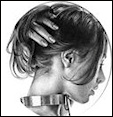 |
The slave collar. Word used to display the pronunciation of "collar". | K |
| Koo | completely, totally, fully, well (as in well- done) | K |
| koora | strip of red fabric worn as a headband by the slavegirls of the Wagon Peoples | |
| ko-ro-ba | 1. village market (obsolete); 2. cap. a major city-state, often referred to as the 'Towers of the Morning' | |
kort |
a rinded fruit of the Tahari; served sliced with melted cheese and nutmeg | |
| kosis | disease | |
| Kris / Krisa | belt (a Kris-knife is a belt-knife) | K |
Kur / Kurii |
1. 'beast'; pl. kurii; a corruption of their name for themselves): a large (8-9') furred, mammal having 4 legs, which can stand upright or on all fours; each paw has 6 multiply-jointed digits with retractable claws and an opposing thumb, so that it can grip; it has 2 rows of teeth; they are incredibly strong and ferocious, and are carnivorous, even to eating humans. Race of beings that sought to overtake Gor from the Priest-Kings. 2. Highly militaristic and organized, with divisors and multiples having to do with seemingly, a base-twelve mathematics, a Kur is a Kurii military unit formed of two Hands and two Eyes | |
| kurdah | a small, light, semi-circular tent, c. 3' in diameter and 4' high, carried by a pack kaiila, in which women (slave or free) may ride; the frame is of tem-wood and is covered with layers of white rep-cloth; used mainly in the Tahari | |
Kurii Brand / chain and claw brand |
Brand of Kurii slaves. | |
| Kurii axe | great, double-bladed iron axe some seven or eight feet in height. The blade, from tip to tip is two feet in width. The handle is made of carved, green needle wood, round and four inches in diameter Book 9: Marauders of Gor, page 171 | |
| Kurii Shield | a wide iron shield, round and four feet in diameter. Book 9: Marauders of Gor, page 171 | |
| kurt | five bladed slave whip | |
| Kurtzal | Village port located on the Lower Fayeen River in the Tahari. | |
| Kuval | leader, high one | K |
| Kwad Paga | Ale-like Drink | K |
| Kwafti | (to) taste | K |
| Kwani | (to) become, get, have done, (slang) Why don't you... | K |
| Kwar, Kwara | kind, gentle | K |
| Kworti | (to) force submission, train (related to English quirt, a whip | K |
| La | Feminine. I am; you are | |
| La Kajira | I am a slave girl. | |
| Laager | A wagon encampment; it is a defensive wagon formation utilized by wagon peoples. Wagons are arranged in a circle, end to end, tongues inward, and chained together, the front axle of one wagon chained to the rear axle of the next. The peoples and livestock are protected within. | |
| Laashi / La'ashi | (to) exit, leave | K |
| Laba | oath | K |
| Lady | a term of respect used to address a free woman. A contradiction exists in the books. Although we are told free women are always addressed as 'Mistress', there are instances where a slave uses 'Lady' without rebuke. Book 11: Slave Girl of Gor, pages 309,389 and 381 Book 18: Blood Brothers of Gor, pages 386-387 Book 19: Kajira of Gor, page 219 Book 14: Fighting Slave of Gor, page 22 | |
| Lake Ngao | an equatorial lake of the Jungles of Schendi, the Ua River enters it's eastern extremity, connecting this Lake to Lake Shaba in the NE corner of the rainforest. 'The Falls of Bila Haruma', named for the famed explorer of this region, lies 100 pasangs to the east. The villages of Unkungu are located on the NE shore. Nyundo is the central village of the Ukungu region. Book 13: Explorers of Gor, pages 100, 454, and 455 | |
| Lake Shaba | located in the NE corner of the Schendi rain forest, it is the source of the great river Ua. Originally named Lake Bila Haruma for the explorer who discovered it, the name was changed at the great explorer's request by Tarl Cabot. Book 13: Explorers of Gor, page 454 and 455 | |
| Lake Ushindi | drained by the Kamba River and Nyoka River, it is a large, equatorial lake, located in the Jungles of Schendi. The inland village of Nyuki is located on the north shore. It's western border is made up of bogs, marshes, and floodlands. A canal connects Lake Ushindi east across the swampland to Lake Ngao. Book 13: Explorers of Gor, page 100 and 455 | |
| Lamp of Love / Ravishment lamp | When a master wishes to make sexual use of his slave girl, he tells her to light the lamp of love, and place it in the window. This sends the message that he wishes not to be disturbed. A small tharlarion oil lamp for a master's chambers, only light enough to illuminate a slavegirl as she is raped | |
| lance | The lances of the Wagon Peoples are not couched. They are carried in the right fist, easily, and are flexible and light, used for thrusting, not the battering-ram effect of the heavy lances of Europe's High Middle Ages. Needless to say, they can be almost as swift and delicate in their address as a saber. The lances are black, cut from the poles of young tem trees. They may be bent almost double, like finely tempered steel, before they break. A loose loop of boskhide, wound twice about the right fist, helps to retain the weapon in hand-to-hand combat. It is seldom throw. (Nomads of Gor, book iv, page 15) | |
| Lance and Tospit | A popular game of the Wagon Peoples. Often, the game is played cruelly involving the use of the "living wand." | |
| Lanceolate | Refers to the lance-like shape of leaves, such as on a tree (Flahdah Tree). | |
| Lang Gim | A bird common in the Ushindi. | |
| Language, The | the fierce, sweet, liquid speech of a native Gorean. Book 3: Priest Kings of Gor, page 52 Book 13: Explorers of Gor, page 10 | |
| lar | central | |
| Lara | Port town located on the Vosk River. | |
| larl | a large (7 ft. at shoulder) feline, tawny red or black in color, having a black mane; carnivorous; similar to a lion | |
| larma | succulent fruit, apple-like; sometimes sliced and fried, and served with browned-honey sauce; offering a larma, real or imagined, by a slavegirl to her master is a silent plea for the girl to be raped; fruit with a hard shell, brittle and easily broken, which encloses a fleshy endocarp, juicy and delicious. When a female is referred to as a 'larma', it is meant that her frigid exterior conceals a quite different interior. Larma or other fruit may be offered by a kneeling slave to her Master in a quiet plea for his sexual use of her. Book 10: Tribesman of Gor, page 27 and page 37 Book 23: Renegades of Gor, page 437 | |
| Lar-Torvis | central fire'; the sun | |
| Lasha | Damn | K |
| Last Girl/ Low Girl | used to denote either the newest girl on a chain, or the least of all the girls. Book 17: Savages of Gor, page 240 The opposite of First Girl |
|
| Last Spear | Used traditionally in hunting, the one chosen as Last Spear is the hunter deemed the weakest, the least skilled. He stands at the end of a hunting line, his spear cast first at the beast being hunted. | |
| last veil | the innermost of the five veils worn by free women; it is worn under the veil of the citizeness, and is often very sheer | |
| Latch Bar | Doors that do not have cylinder locks or some other form of lock, often have latch bars; often these bars have a hole drilled which allows the use of a cording to be used as a lock, secured by a signature knot. | |
| Latch Hole | In rooms which are not afforded a lock on the door, often found are latch holes, used for inserting a latch string, which is connected to the latch bar. | |
| Latch String | A piece of string which is connected to the latch bar on a door so as to permit entry into a room. | |
| Lateen | A triangular shaped sail; considered by mariners to be the most beautiful type of rigging, as compared to the squared rigged ships. | |
| Laura | Small trading city along the Laurius River. | |
| Laurius River | One of the major tributaries on Gor. | |
| Laving Bowl / Laver | Wash basin. | |
| Law of the Home Stone | Being that whenever one speaks of the home stone, much honor is involved. Should one blasphemy or desecrate the home stone in some way, punishment is generally death. | |
| Lay/Laym | Bad | K |
| laybis | bitch | K |
| Laybisti | female derogatory, probably means 'dyke' | K |
| Lazj/Lazja | Chest, Container, Box | K |
| Leach/Leech | Blood sucking worm found. | |
| Leading Chain of Ten | Long chain, which can hold up to ten slaves, and used as a leash. | |
| leading position | She stands and moves behind her Master, bending at the waist. She places her hands behind her and puts the side of her head to her Master's hip, that he might lead her easily by the hair or collar while walking. | |
| Leaf Urt | One of the several varieties of rodents. | |
| League of Taverners | Governing group of tavern owners which oversees the registration and copyright of tavern names. | |
| League of Black Slavers | Dark-skinned members of the Caste of Slavers; indigenous to the Schendi region. | |
| leash | 1. various types of rope, fiber, chain, etc. used to restrict a slave from flight or movement. The rope or fiber chains may be corded with wire to prevent them from being shredded by chewing. Book 25: Magicians of Gor, page 195; 2. hair confined into a ponytail with a ribbon or wooden fillet, so called because it can be used as a method of seizure and control by the Master. Book 22: Dancer of Gor, page 112 |
|
| Leash Paces | In the training of new slaves, this indicates the use of the leash by slaves to test her responsiveness. | |
| Leasha | This position is used to attach a leash. She kneels, her back to her Master, with her chin lifted and head turned to the left, offering her collar for leashing. Her wrists are behind her back, ready, if needed, to be snapped into slave bracelets. | |
| leashed legs tie | a standard submission tie; the kneeling girl has the leash, attached to her collar, passed down the front of her body and between her legs to bind her crossed ankles together. Book 14: Fighting Slave of Gor, page 244 | |
Leather [Finger] Tab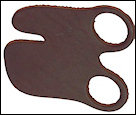 |
Leather piece with two holes for slipping through fingers; used in conjunction with the long bow as protection. | |
Leather Bracer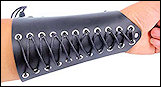 |
Worn on the arm as a protective shield while using the long bow. | |
| Leather Streamers | Tarn reins. | |
| Leather Worker, Caste of | One of the Low Castes. | |
| Leech Plant/ Leech Vine | a hemovorous plant that fastens two hollow, fang-like thorns into its victim, through which it can suck the blood that nourishes it | |
| Leem | A small, arctic rodent. | |
| leg-spreader | devices of various complexity designed to keep a slavegirl's legs spread while being used sexually by her master(s); sometimes used on male captives as an indication of humiliation; used mostly among the Red Savages of the Barrens | |
| lelt | a small (5-7") blindfish with fernlike filaments at either side of the head which are its sensory organs; white, with long fins, it swims slowly, and is the main food of the salt shark; inhabits the brine pits such as those at Klima in the Tahari | |
| Lengi | (to) lick, (to) tongue, (to) "suck" | K |
lesha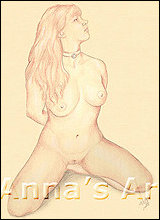 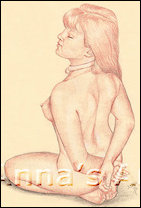 |
leash' at this command, the slavegirl stands with her hands behind her back, ready for binding, and with her head back and chin to the left, ready to have a leash snapped onto her collar | |
| Leshi | (to) kneel | K |
| liana vine | a rainforest plant which can be used as a source of drinking water | |
| Lice | Pesky insects, often found on ships, as well as infesting birds; the larger variety of lice infest the tarn. | |
Lichens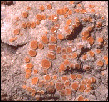 |
In times of hunger, men of the seas often chew on these mosslike plants which grow along rocks. | |
| Light Class | Denotes the size of a ship; the smallest, lightest war galleys, used mostly in patrols and communications. | |
| Light Diversion Rings | One of the rings designed by the great Kurii scientist, Prasdak. See also: "The Five Rings" and "Invisibility Ring." | |
| Lighter Of Lanterns | A person who wanders the streets of a city announcing when it is time to light the lanterns. | |
| limits | "Be strong and do as you will . The swords of others will set you your limits." (pg. 9, Tribesmen of Gor) | |
| Lina | Heart | K |
Linen Paper |
Heavy, glossy paper manufactured in Ar. | |
| lit, common | a bird found in the rainforests of the Schendi area | |
| lit, crested | a bird found in the rainforests of the Schendi area | |
| Livery | As defined in the dictionaries of Earth: clothing, uniforms, attire. Used in the same meaning in the books, used in the meaning of all clothing and uniforms on Gor, free and slave alike. | |
| Living Wand | A popular, though dangerous, use of slave girls in the game of the Lance and Tospit. Instead of the tospit placed upon an inanimate object (the wand), the tospit is held in the mouth of a slave girl, thus becoming a "living wand." | |
| lo | masc. I am; you are | |
| Lock Collar | A slave collar which is locked with a key released lock. | |
| Lock Gag | Made of leather and metal; used on slaves. | |
| Lock-Collar Girl | A slave which has been given a lock collar to wear. Generally, these slaves are trained slaves. | |
| Locksmith | A member of the Caste of Metal Workers. | |
| Lod/Loda | Dirt | K |
| Long Bow | Considered the weapon of peasants. | |
| long ship | a swift, maneuverable ship having 2 rudders, 1 removable lateen-rigged mast, and a keel-to-beam ratio of 8:1; often used in military actions; some are fitted as ramships | |
longhouse, Torvaldsland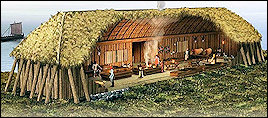 |
the hall of the Torvaldslander is about 120 Gorean feet in length, with walls formed of turf and stone, some more than eight feet in thickness. It is heated by a fire in it's center, burning in a rounded pit. It's ceiling, supported by posts is about 6 feet in height. At one end is a cooking area and along each side, stones mark sections off into sleeping quarters, furs strewn over an dirt floor. Scattered throughout are tables and benches. The center of the hall proper is about twelve feet in width. Book 9: Marauders of Gor, pages 90-91 | |
| Looking into the Blood / Ritual of Sleen Hunters | Gorean ritual where a hunter drinks a handful of blood from his prey, then takes another handful and looks into it to see his future, before drinking it. It is said that if one sees one's visage black and wasted, one will die of disease; if one sees oneself torn and scarlet, one will die in battle; if old and white haired, one will die in peace and leave children. Book 2: Outlaw of Gor, page 38 | |
| loot pit | a holding place for captured free women awaiting collars and branding during the military occupation of a city. Book 25: Magicians of Gor, page 190 | |
| Lot Number | Number assigned to a slave girl at an auction house. | |
| Love Dance Of The Newly Collared Slave Girl / Love Dance | the dance has many variations, in the different cities of Gor (which each have their own distinctive music), but the common theme is that the girl dances her joy that she will soon lie in the arms of a strong Master | |
| Love Feast | common name for the 5th Passage Hand, occurring in late summer, which time is the greatest period for the sale of slaves, esp. slavegirls | |
| love furs | soft furs spread thickly on the floor at the foot of a master's sleeping couch, on which a slavegirl is most often raped | |
| Love War | An annual event, in which games are played between Turia and the wagon people. | |
| Luck Girl | a slavegirl who acts as mascot onboard ship; her use is usually reserved for the captain of the ship, but she may be shared with the crew, usually as a disciplinary measure | |
| Ludi | Ancient Roman games. | |
| Lung Fish | Fish found in the salt waters in Klima; much like the Gint. | |
| Luraz | a minor tribe of the Tahari; they are a vassal tribe of the Aretai | |
| lure girl | slaves who are set out by their master's to entice men for the purposes of impressing as crewmen or in work gangs. While the man is delightfully distracted, her master's men accost him and hustle him away. Book 22: Dancer of Gor, page 244 | |
| Lute |
A musical instrument. | |
| Lydius | Free port city along the Laurius River. | |
Lyre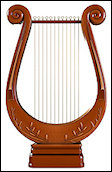 |
A stringed musical instrument. |