Rope Glossary A-M
Note about this glossary: The Japanese terms for these ties refer to positions, rather than the tie itself, while English terms often refer to the ties themselves.
| Abrasion | Rubbing the rope against something, especially something rough. Wears a rope, caused by rubbing or dirt in the rope |
Aglet |
a permanent ending applied mechanically to bind the end of the rope. A typical example is the plastic aglet at the end of a shoelace. |
| Agura Shibari | any Japanese rope bondage tie where the sub sits in a crossed legged (tailor) position. This tie should not be confused with the far more restrictive ebi shibari. |
Alpine Butterfly Loop / Lineman's Loop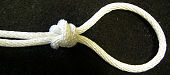 |
A flat, non-cinching loop anywhere in the working end. Western Bondage. Alpine Butterfly Loop (Lineman's Loop) Tying Wrap the rope around your hand twice. At the end of turn one, position the rope close to your fingertips. Continue around and complete turn two back near your thumb. Pick up the turn near your fingertips. Wrap it around the other two turns. Slide the knot off your hand and tighten by pulling on the loop and the ends. |
Anchor Hitch |
Stronger than a half hitch and may be used for suspension except around a pole. It should not be used for body work as it tightens under pressure. Pass the tail twice around the post keeping the second turn slack. Pass the tail over the standing end and under the original slack turn to tie the first Half Hitch. Continue around the standing end to tie the second Half Hitch and complete the knot. |
| Aomuke Zuri | Suspended face up |
| Aramid | Synthetic; heat-resistant and strong; fibers in which the chain molecules are highly oriented along the fiber axis; After production of the polymer, the aramid fiber is produced by spinning the dissolved polymer to a solid fiber. |
| Aranawa | rice rope |
| Asa | hemp - used as a type of fiber, not a specific plant |
| Asanawa | 3 loose laid rope made of three types of jute. It softens with treatment and use. Shibari rope is usually 7 meters in length and between 6 to 8 mm in width. Usually a knot is tied at each end so that these "buttons" can be used for certain wrapping style or hojōjutsu ties where no real knot is ever used to secure the tie because the button holds the rope(s) in place. |
Ashley Stopper Knot / Oysterman's Stopper |
An excellent bulky stopper knot. Make a bight and fold it into two loops. Pass the loop in the standing end through the other loop and then tuck the tail through it. Tighten the Half Knot first. Then pull the tail tight and finally the standing end. The underside of the knot shows three separate lobes. |
| Back splice | uses a stranded rope's own fibers to prevent fraying |
| Ball Tie | A specific form of bondage in which the person is bound in a seated position with the knees up, the head bent down over the knees, and the hands behind the back. |
| Bayu | A traditional rope treatment product made from horse fat. |
| Bend | a knot used to join two lengths of rope. |
| Bight | A loop or bend made in any part of a rope, that does not cross itself, often in the middle |
| Binding Knot | knots that either constrict a single object or hold two objects snugly together, the ends of rope are either joined together or tucked under the turns of the knot |
| Bitter End | the end opposite the end in use. The last part of a rope. |
Boola Boola |
a non-cinching knot that combines a non-cinching overhand knot with half hitches (two or three) along the standing end. Eastern Bondage. |
Bowline Knot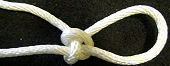 |
Form a small loop leaving enough rope for the desired loop size. Pass the end of the rope through the loop as though making an overhand knot. Continue around the standing end and then back through the small loop. |
| Bowtie Knot | A cinching double loop often used for handcuffs. Western Bondage |
| Box Tie | A specific form of bondage in which a person brings his or her arms together and grips each forearm with the opposite hand, and then ropes are brought around the forearms to tie them together. Often combined with ropes between the upper arms to prevent the bound person from slipping his or her arms sideways out of the tie. |
| Brait | a combination of braided and plaited, a non-rotating alternative to laid three-strand ropes; excellent energy-absorption characteristics |
| Burn Speed | how fast a rope is pulled across skin to really hurt. Natural fibers tend to have higher burn speeds (they're less likely to burn) and synthetic fibers tend to have lower burn speeds (they'll burn if you look at them cross-eyed). |
| Cable | three hawsers twisted together |
| Capsizing | a knot that has deformed into a different structure due to incorrect tying or deliberately to strengthen it |
| Captured Loop / Monkey Twist | A loop created in the working end secured by a half hitch. Eastern Bondage. |
| Chirality | the 'handedness' of a knot |
| Chokuritsu fudou ippon shibari | Upright standing binding |
| Cinching Knot | A cinching knot will tighten under pressure. A type of knot made by passing a rope or line through an opening, then around and around itself several times, and finally through a loop near the opening. |
| Clove Hitch | easiest and most used hitch; not for suspension or around the body as it tightens under pressure. Pass the end of the rope around the pole. Continue over the standing end and around the pole a second time. Thread the end under itself and pull tight to form the clove hitch. |
| Coir | Natural Fiber; made out of the fibers from coconut husks and is very weak, but it floats; remarkably uncommon |
| Column | a long body part, i.e. arm or leg. |
| Cordage | ropes or lines |
Cotton |
Natural Fiber; soft, flexible and stretchy and usually comes in a warm off-white color. The center core in most cotton ropes is not solid or strong and may not be good for bondage. Jammed knots are impossible to untie. |
| Cross knot | Decorative Vietnamese Knot. Western Bondage |
| Cut Splice / "Cunt" Splice | a join between two ropes, made by side splicing the ends slightly apart, to make an eye in the joined rope which lies shut when the rope is taut. |
| Design Factor | a ratio based on risk |
| Diamond Braids | manufactured by weaving ends of yarn over and under, may be formed with or without a core. If there is a core around which the rope is braided it cannot be spliced |
| Directional Pull | a place not to stand in the way of. The rope may break an the rope will fly in the direction of the pull, possibly causing injury. |
| Double Braided / Braid On Braid | Two braided ropes combined into one, one inside the other; typically stronger than a laid rope. Easily spliced. Much stronger than single braid. Often of polypropylene, nylon, and polyester; frequently the inner braid is a stronger material and outer material is abrasion resistant. This is the strongest and most expensive of all rope. |
| Double Coin Knot | Decorative Chinese Knot. Western Bondage |
| Double Column | a non-cinching tie that binds and separates two body parts (e.g. first tying the wrists together and then running the rope between the wrists to separate them) |
Double Loop Bowline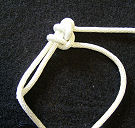 |
The Double Loop Bowline is a more secure way to tie a bowline in a doubled rope. This knot was most often used at sea to lower an injured man by putting one leg through each loop. |
Double Overhand Stopper |
Form a loop in the rope. Pass the end through it. Pass the end through the loop again. Tighten the knot to make a secure stopper knot. |
Dragonfly Sleeve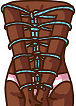 |
An arm bondage |
| Dressing | arranging a knot in such a way as to improve its performance. Crossing or uncrossing the rope in a specific way, depending on the knot, can increase the knot's strength as well as reduce its jamming potential |
| Eastern Bondage | Shibari. Typically uses rope doubled over in the middle |
| Ebi Shibari | The "shrimp" or "prawn" tie. One of the oldest traditional kinbaku ties. It was used as a torture technique (ebizeme) for 100's of years and is referenced in many manuals and art works. |
| Ebizeme | Being bound by rope. To be punished by being tied in the ebi ("shrimp" or "prawn") tie was a form of torture that was mandated by the Tokugawa shogunate in 1742 as one of 7 official punishments for criminals and enemies of the state. In the short term the ebi shibari is a fun position for SM play but can be quite an ordeal over time. |
| Elbow | two nearby crossings of a rope |
| End splice / back splice | A splice where the strands of the end of the rope are spliced directly back into the end without forming a loop. It is used to finish off the end of the rope to keep it from fraying. |
| Eye splice | A splice where the working end is spliced into the working part forming a loop |
| Fid | used to hold open knots and holes in canvas, and to separate the "lays" (or strands) of synthetic or natural rope for splicing, made of wood or bone. |
Figure Eight Knot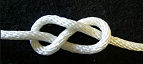 |
Pass the tail over itself to form a loop. Continue under and around the standing end. Complete the knot by passing the tail down through the loop. |
Fisherman's Knot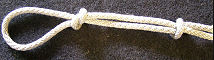 |
(or Water Knot, or Angler's Knot) often used to securely combine two lengths of rope by laying them parallel and tying an overhand knot in from one standing end to the other and vice versa. Western Bondage |
| Flake | turns in a coiled rope |
| Fraps | a set of loops coiled perpendicularly around the wraps of a lashing as a means of tightening |
| French Bowline Knot | will not tighten and cut off circulation. |
| Friction Hitch / Slide And Grip Knot | a knot that attaches one rope to another in a way that allows the knot's position to easily be adjusted. |
| Frog Tie | A specific form of bondage in which the person kneels and the ankles are bound to the thighs, preventing the person from rising; the wrists are then bound to the ankles. |
| Fumo-tsuri | Suspension by one crooked leg. |
Fusion / Burning |
The ends of some man-made fibers such as Dacron, Nylon, polyethylene, polyester, and polypropylene may be melted or burnt to fuse their fibers to prevent fraying |
Futomomo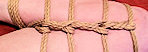 |
(Japanese for "fat thigh") which is a traditional leg binder. |
| Gote Shibari | The basic box tie, the building block of most shibari tie, meaning "arms behind back". There are many variations of this from the simple to the complex. Foundation form for many shibari ties, capturing the upper body / breasts and arms in a "U" shape behind the back. Often mistakenly called takate kote or TK, prefixed sometimes by 2R- or -3R to denote 2 and 3 rope variants. |
| Gyaku-Ebi | A reverse ebi, very similar to the western hog-tie, "inverted shrimp" |
| Gyaku-Ebi Zuri | gyaku-ebi, but suspended from rope. In this position both legs are suspended individually. |
| Half-Hitch | an overhand knot tied around the standing end; only for binding rope to a hard point, not for body or suspension. Eastern Bondage. |
| Hashira Ushirodaki Shibari | Tying someone using a wooden (usually a bamboo) pole. |
| Hawser | three stranded laid rope |
Hemp / Abaca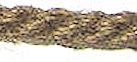 |
Natural Fiber; the most common ropemaking material all over the world for a very long time. It makes the strongest natural ropes with decent stretch and is quite soft and pliable. It takes dye well, so you can get it in just about any color. Hemp rope tends to decay quite quickly. Made from cannabis, may be entirely made from the plant or blended with other fibers including cotton and silk. |
| High-Modulus Polyethylene | Synthetic; Dyneema and Spectra are lightweight high-strength oriented-strand gel spun through a spinneret; extreme abrasion resistance; low weight, low bulk, often combined with nylon, low density, low elasticity, low knot-holding abilty except the triple fisherman's knot. Floats on water. Usually 12 strands forming tube; looks like pajama cord; slippery so doesn't hold knots well and splicing may be difficult. "Racing Dyneema" is the same rope with tightly braided polyester outer sheath so is can be gripped by machines. "Cruising Dyneema" is less expensive than racing Dyneema; it is made thicker with polypropylene then sheathed with polyester. |
| Hishi Shibari | Taken from early hojōjutsu techniques, this tie creates a diamond shape. When done as a full body tie, it is sometimes also called hishi-kikkou. The hishi has been popularized by manga, or cartoon, art. |
| Hishigata | diamond shape |
| Hitch | a knot that attaches a rope to another object or to another rope; when attaching rope to a fixed object (this object can also be rope) the knot is called a hitch |
| Hog Tie | A bondage position there the bottom is on his belly with both arms bound with knees bent and ankles bound and secured to the wrists. Also, a cross shaped strap of leather with clips on each end to attach to wrist and ankle cuffs to effect the bondage position. |
| Hojōjutsu | 15th Century martial art form. Japanese rope tie or technique being used by a person in a martial arts context and restraining prisoners. Signified by a lack of knots as it was considered shameful for people of a higher status to be bound. While it is no longer practiced today, it is thought to be the origin of modern Japanese Rope Bondage, aka Shibari. |
| Hollow Braid Construction | Diamond braid without a core. Small (usually only up to 1/4") and extremely flexible, but not remarkably strong. The outstanding feature of hollow braided rope is the ability to splice it. |
| Jamming | any knot that becomes very difficult to untie after use |
| Joshuu | female prisoner |
Jute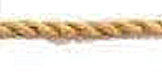 |
Natural Fiber, very common material for making ropes in Japan. |
| Kami | any technique or tie that involves the hair, such as by weaving ropes through the hair to hold the head immobile. |
| Kanashibari Shibari | binding hand & foot |
| Kataashi age tsuri shibari | One foot lifted partial suspension |
| Kata-Ashi Tsuri (Zuri) | one leg up suspensions |
| Katate Kubi Shibari | Single wrist binding |
| Kazushi | Messy style |
Kernmantle Construction / Sheath and Core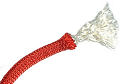 |
braided or twisted sheath (or mantle) that protects a very strong core; the core and sheath may move independently of each other. The sheath is woven, hollow braid. The core can be a solid braid or it can be made from parallel or gently twisting yarns. she usually made of nylon with sheath made of polyester. For non-stretchy uses, polyester may be used for both. These ropes are very strong with low stretch and low abrasion and are used for applications like climbing where your life depends on your rope. Can not be spliced. |
| Kevlar | usually with a polyester braid; expensive |
| Kikkou Shibari/ Hon Kikkou | The famous tortoise shell tie so called because the pattern created resembles that found on the Japanese tortoise. This can be full body or only torso. There are several styles of kikkou shibari taught. The traditional style creates one or more hexagonal shapes on the bound subject. A second style, popularized in manga illustrations, creates at least three linked diamond (hishi) shapes running from the neck to the pubic area. |
| Kinbaku | A verb meaning "to bind tightly" and describing the sexual exchange between two people enjoying a session of Japanese rope play. Specifically noted by the use of natural fibers such as jute, usually single colored rope, 5-7 mm diameter rope, about 7-8 meters long and finished in a single knot. There is a focus on functionality of the bondage using weaves rather than knots and the rigger actively targets erogenous zones. The lack of knots refers to hojōjutsu customs. While the terms Shibari and Kinbaku can be used almost synonymously, Kinbaku often refers to more sexually explicit rope scenes. |
| Kinbaku-Bi | the beauty of tight binding shibari done in the traditional manner for an aesthetic / erotic effect. |
| Kinks | Sharp bends that greatly reduce te strength and life of the rope. Passing a kink through a pully will serious damage the rope. |
| Knot | two strands of rope tied together (imagine shoelaces) |
| Kotori | A rope harness intended to support a person's weight from the torso and upper legs, used for suspension in shibari. |
| Kukuru | to tie up |
| Lacing | 1. The practice of extreme corsetry; particularly, very tight corsetry done as a form of body modification. 2. A specific and unusual type of bondage done by suturing a part of the body to or around a fixed object. 3. Any functional tie used to close an article of clothing, such as boots or corsets. 4. Any style of bondage involving restraining a person by tying a cord or rope over the person and around many fixed points. See related lacing table. Commentary: In the sense of def. 2, the practice of lacing is often considered edge play and may not be safe if done by a person who is not skilled and knowledgeable. |
| Laid Construction / Twisted Construction | the fibers of the rope were twisted into yarns which were then twisted into strands, which were finally twisted into rope. The vast majority of laid rope is of 3-strand construction (some may be 4). Usually natural fibers but often nylon or polypropylene. Left and right handed twists that effect how the rope coils and handles. Easily spliced. Commonly available, most affordable, but not as strong as other rope of similar diameter and strands can separate under abrasion and cause twisting under heavy loads. Not perfectly rounded. The fibers within each of the three strands must twist in the opposite direction as the strands in order to produce a balanced rope, that is, one which hangs straight and resists kinking. Twisted rope must be fused and taped on each end to prevent unraveling. |
| Lapp Knot | if tied correctly, a very secure, non-collapsing, non-cinching relative of the bowline, which can easily be converted into a slip knot. Eastern Bondage. |
Lark's Head / Bale Sling / Ring Hitch/ Cow Hitch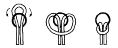 |
Larks head is a direct translation of its French name but has many other names. The Lark's Head knot is used to attach a rope to a spar or ring. Two half hitches facing one another to create a cinching loop, the Lark's Head is most commonly used to extend rope. Eastern Bondage. |
| Lashing | an arrangement of rope used to secure two or more items together in a rigid manner |
| Linen | produced from the flax plant; similar to hemp rope, but tends to be a little softer and 'fluffier' |
| Liquid Crystal Polymer | Synthetic rope, resistant to fire, high strength |
| Liquid Whipping | a semi-permanent rubbery coating applied by dipping the cut end of a line into a container of the product. When the coating sets it is flexible but solid enough to keep the rope together. Liquid whipping can be used on both natural and synthetic fibers |
| Load-Bearing Double Column | binding the double column in such a way that the wrists can be tied overhead and tension added |
| Loop Knot | knot that forms a fixed loop |
| M Ji Kaikyaku Tsuri Shibari | Hanging letter M, open leg binding |
| M Zuri | Suspended from the takate kote with the thighs in front |
| Macramé | Utilizing decorative knots and weaves in rope bondage. |
| Maete Shibari | A tie in front of the body, arm tie |
Manila |
Natural Fiber, hard, resistant to sunlight, does not melt but does burn. Holds knots firmly and stretched very little. Must be stored dry to avoid mildew. Moderately strong, stiff, low stretch. Often coated with oil to resist rot. |
| Marlinspike | a polished metal cone tapered to a rounded or flattened point, they aid in such tasks as unlaying rope for splicing, untying knots, drawing marline tight using a marlinspike hitch, and as a toggle joining ropes under tension in a belaying pin splice. |
| Matanawa | any pubic area tie or "crotch rope." |
| M-jo / M-o | the most widely accepted term in Japan today for the one captured in rope, though many prefer the term "models"; m-o "male m-jo"; M stands for masochist |
| Momo | thigh, peach. Momo shibari is a form of tying the thighs so the sub is forced to kneel with the head low to the floor and the buttocks raised so they resemble a peach |
| Multibraid Construction | solid braid, usually with four strands. |
Mune Nawa |
Breast/Chest bondage |
Munter Hitch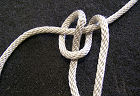  |
More elaborate than a half hitch, it creates more friction and is consequently sturdier. Eastern Bondage. |
| Musubime | knot |
| Musunde | tying a knot |