Rope Glossary M-Z
Note about this glossary: The Japanese terms for these ties refer to positions, rather than the tie itself, while English terms often refer to the ties themselves.
| Nawa 縄 |
Traditional Japanese style bondage rope made of hemp. |
| Nawa Junjun | Japanese rope bunny |
| Nawa Yoi | Literally ‘rope drunk'. Sub-spaced. |
| Nawashi | A maker of rope; Rope artist; professional |
| Newaza | Floor work |
| Non-Cinching Knot | will not tighten under pressure |
| Noose | a sliding loop the tightens when pulled |
Nylon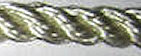 |
Synthetic; the first synthetic fiber used to make ropes. It is stretchy up to 40%, pliable, and strong with fairly low memory and decent knot-holding abilities. You can get it in just about any construction imaginable. 10-15% weaker when wet. Absorbes shock loads well. When stretched it has a "memory" for returning to its original length. |
| One-Column Tie | In bondage, any form of tie which binds one of the body to something else; as, for example, any tie which binds a wrist to a fixed object such as a headboard. |
Overhand Knot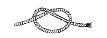 |
The overhand knot is one of the most fundamental knots, and it forms the basis of many others, including the simple noose, overhand loop, angler's loop, reef knot, fisherman's knot, and water knot. The overhand knot is a stopper, especially when used alone, and hence it is very secure, to the point of jamming badly. |
Parachute cord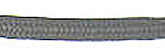 |
braided over a monofilament core, is soft and strong, but it is too thin for most uses |
| Polyester | Terylene or Dacron. Synthetic; strong, offers good resistance to abrasion and load cycling. Does not stretch like nylon because most are prestretched but does wear better after repeated use and almost as strong. Sited for static lodad like standing rigging. Resists sunlight. Does not float. Flexible. When double braided, is some of the strongest rope available. Because it des not stretch, it can not handle shock loads. To knot, use a soft-laid for greater flexibility. For straight lifting and strength, use a hard-laid type. |
| Polyethylene | Synthetic; Similar to nylon. PE rope is almost as strong, but not quite as stretchy as nylon. Retains most of its strength when wet. Monor or multifilament, degrades in sunlight and though high-temperture oxydation; low melting poing. Hould not be used under friction. |
| Polypropylene |
Synthetic; floats, does not biodegrade but does photodegrade, extremely stiff, though, with very high memory which makes it difficult to difficult to knot. Becomes sharp and bristly when degrading. Medium strength, low elasticty. |
| Punishment Tie | Any form of bondage done in such a way that the bound person's pose or the bondage itself is painful or uncomfortable, or any kind of bondage done with the intent of causing pain or discomfort to the bound person. Some forms of shibari include punishment ties. |
| Rayon | used mainly in sailboats, has all the advantages of nylon, only is more expensive |
| Renkou Tejou shibari | Prisoner handcuff binding |
| Rigger | A person that practices tying people up, usually with rope. Works with rope bottoms and bondage models. May also practice self-rigging and suspension. |
| Rigging | the mechanical sailing apparatus attached to the hull in order to move the boat. In BDSM, it's the rope used to bind or suspend a bottom. |
| Rope Cuff | Any form of tie which binds the wrists or ankles together. |
| Rope Dress/Karada | A full body harness made of rope, often features traditional Japanese patterns such as diamonds, triangles or hexagons. Typified by a diamond pattern of knots and holes which contains but does not restrict the body. A rope dress. |
| Rope Lock | a device used in a counterweight fly system to prevent a rope, and the line set it controls, from moving. The lock is controlled by a steel handle that engages the lock when vertical and releases it when horizontal. |
| Running Rigging | cordage used to control the shape and position |
| Ryo-Ashi Zuri | Suspending your model with both legs together, i.e. binding both ankles together. |
| Ryo-Tekubi Shibari | Both wrists tied together. It does not matter where the wrists are, or if the tie is cinched, as long as the wrists are tied together. |
| Ryouashi Gattai Ichimonji Shibari | Legs bound together |
| Safety Shears / EMT Scissors | A useful tool for safely cutting people out of things, especially clothing. Are not always optimal for cutting rope. |
| Sakasa Zuri | Inverted suspension, the m-jo is hanging head down and the body vertical, not supported by a tsuri nawa on the takate kote. |
| Santen Zuri | Suspended from the takate kote with the ankles in front. Sort of sitting position. San means three, this refers to the number of suspension lines. Another word for santen zuri is M zuri because the body and the knees up form the letter M. |
| Seizing | a knot that binds two pieces of rope together side by side, normally in order to create a loop |
| Sensei | Teacher, Master, Doctor; he who has gone before. |
| Setting | the process of tightening a knot |
| Shibararetai | A bottom publicaly indicating his/her desire for bondage action. |
| Shibari Do / Shibari | The act of the Japanese art of decoratively tying. May be rope or ribbons. Specifically refers to the art of tying and the study thereof. Not specifically bondage related. In bondage use, natural or natural looking fibers are preferred. Colored ropes and knots are acceptable as the aesthetic of the tie is the tantamount goal. Japanese for "to tie", in the BDSM community it refers to contemporary forms of Japanese Bondage. Though the history of Shibari cannot be traced definitively, it's thought to have originated with the Eastern Martial Arts form of Hojōjutsu. It is consequently not surprising that common forms found in Shibari resemble stress positions such as a Strappado or hog tie. Many other forms are intended to expose or shame the rope bottom. Symmetry and deliberate asymmetry, as well as geometric patterns are a large part of the aesthetic of Shibari. However it should be noted that Shibari is not a type of decorative tying, though the aesthetic of a tie is important, the purpose of the tie is to restrain, immobilize and sometimes torture the bottom. Traditionally Shibari uses natural fiber rope, such as jute or hemp, that is roughly 5 - 7 millimeters in diameter and 8 meters long. Shibari utilizes very few knots and typically relies on hitches for the structure of the patterns. See Kinbaku and Hojōjutsu. |
| Shibari Sensei | A term invented in the western world to describe a Oriental rope master/artist. |
| Shibaritai | A top indicating his/her desire for bondage action. |
| Shibaritsukeru | to tie |
| Shinju | pearl or "nipple", shibari involves breast bondage. A shinju does not restrict motion, and can be worn under clothing; as the subject moves, the ropes shift against the breasts, providing constant stimulation. |
| Shock Loads | a sudden jerk or strain that may break a rope, even though the rope may be rated to accomodate the same load steadily. |
| Shuuchi Nawa / Shibari | Ties designed to embarrass the subject. |
| Side Splice | A splice in which the end of one rope is joined to the midsection of another. For example, the cut splice (above) is composed of two side splices, with each line's end side spliced to the standing part of the other. |
| Single Braid Rope | Readily available and afforable. Braiding together 8-10 fibers into a hollow/tube braid. Frequently polypropylene and nylon; stronger than laid rope of the same diameter and does not unravel as quickly Flat or oval shaped. |
| Single Column On A Running Line | Best when combined with another single column or a Somerville bowline so that both wrists can be in their own cuffs. |
| Single Column Tie | A non-cinching tie that binds one or more objects or body parts together |
Sisal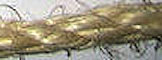 |
Natural Fiber; hard, bristly and splintery but immensely cheap; a pale tan color. The hairiness makes it generally unsuitable for purposes that will put it in contact with skin. It is also pretty stiff and has a lot of "memory" so it holds onto kinks and bends. Little stretch and good knot holding ability. Story dry to avoid mildew. About 20% weaker than manila. made from Aloe cactus plant fibers or Henequen from Agave leaves. Not oil coated, cmpostable |
| S-Jo | Sadist/top (female) |
| Slipknot / Quick Release Knot | In Bondage, a type of knot that can easily be opened from the standing end, usually because the standing end is not threaded through the knot, rather looped through the knot. |
| Slipped Knot | any knot that unties when an end is pulled |
| Slipping Reef Knot |
tied the same way as the square knot, but you fold a loop in left rope end after step one in the above example of a square knot. Then continue tying like a square knot for a quick release. |
| Solid Braid Rope | Solid braid is very firm, round and tightly woven with a special lock-stitch construction which prevents unraveling when cut or torn. Solid braided rope stands up especially well to chafing of blocks and pulleys. This construction cannot be spliced. |
Somerville Bowline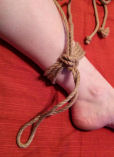 |
Invented by Topologist, a very sturdy, non-collapsing, non-cinching bowline. A very useful single column that can be untied even if the lead is still tied to something. Eastern Bondage. |
Square Knot / Reef Knot |
A simple knot that is used to tie two ropes or the ends of one rope together. The knot is more or less flat and applies less pressure on the skin than most other knots. Tied by one left-handed overhand knot followed by a right-handed overhand knot. Often used to combine two lengths of rope. Western Bondage |
| Standing End | the part of a rope is the part not active in knot tying, typically the beginning of the rope, in Eastern Bondage it's the bight. |
| Standing Rigging | cordage which is fixed in position |
| Stopper Knot | type of knot tied to prevent a rope slipping through a grommet |
| Strappado Bondage | A specific bondage technique in which a person's hands are tied behind his or her back, then a rope is tied to the wrists and attached to an overhead fixture or pulley tightly enough so that the bound person is forced to bend over with his or her arms in the air. Commentary: This is a physically demanding form of bondage which exerts strain on the arms and shoulders and may be dangerous if done by people who are not experienced and knowledgable. |
| Sukaranbo | rope harness which wraps around the buttocks and upper thighs and passes between the legs and over the genitals, passing between the labial lips of a female wearer. The rope may feature a knot at the place where it touches the clitoris. A sukuranbo does not restrict motion, and may even be worn under or over clothing; as the wearer walks or moves, the ropes slide over the genitals, causing sexual stimulation. A traditional tie that emphasises the vagina. |
| Surgeons Knot | Just like a square knot but with an extra twist so it does not slip or bind |
| Tachi Tsuri Shibari | Standing partial suspension |
| Takate - Kote | A type of rope harness, originating in Japan, which goes around the torso and holds the arms behind the back |
| Tanuki | Suspended face down from all four limbs. "racoon dog" |
| Tape | Several turns of self-adhesive plastic tape may form a temporary or emergency substitute for whipping |
| Tasuki shibari | Tasuki (kimono string) tied |
| Tazuki | Criss-cross harness |
| Tejou Shibari | Handcuff binding |
| Teppo Shibari | Named after the Japanese flintlock rifle, the Teppo |
| Tomei Nawa | The safety rope between arms and chest; the cinch. |
| Trinity Knot | Celtic Knot. Western Bondage |
| Tsubaki | Camellia. Used to make an oil used for rope treatment. Also commonly used cosmetically and, historically, for preserving wood and metal |
| Tsuka Maki | Sword hilt wrap finishing where the rope is wrapped around and around other ropes. |
| Tsuri / Zuri | Any rope suspension. The second classic torture technique (tsurizeme) from Tokugawa Japan, now evolved into a mainstay of shibari play and performance. Becomes "zuri" when preceded by another word |
| Tsuri Nawa | Suspension rope |
| Tsurizeme | Being bound and suspended by rope. |
| Two Column Tie | In bondage, any form of tie which binds two parts of the body together; as, for example, any tie which ties the wrists together, or ties a wrist to an ankle. |
| Ushiro Takate Kote Shibari / Takate Kote / | Specifically a ‘high hands' version of gote shibari where the wrists cross in an upwards X-shape. (kote=back of hand/forearm and takate=high hand) |
| Ushiro Tasuki Shibari | The ushiro tasuki shibari is a hojōjutsu inspired bondage. In this pattern the hands are tied in a "W" position on the back and an "X" shape is created between the breast. |
| Ushiro Te Shibari | Hands behind the back binding |
| Ushirode Shibari | A tie on the back of the body. |
| Ushirode-Gassho Shibari / Gote Gasshou Shibari | A tie usual referred to in English as the "reverse prayer tie." This tie is only for the limber! There are Buddhist and Western variations. |
| Waranawa | Rice straw rope |
| Western Bondage | also Fusion Bondage is a style of rope bondage developed mainly in the USA, it combines decorative elements with purposeful tying. Western Bondage often incorporates Chinese Knotting and typically uses synthetic fiber rope such as twisted or woven nylon or multifilament polypropylene. Typically uses single rope |
Whipping Knot  |
a binding of marline twine or whipcord around the end of a rope to prevent its natural tendency to fray. The whipping can be made neat and permanent by tying it off or sewing the ends of the twine through the rope . |
| Working End / Running End | the part of a rope is the part active in knot tying. |
| Working Load | The ratio between the working load and the rope's tensile strength is termed the safety margin. Calculated by dividing the minimum breaking strength of the rope by a predetermined design factor; the ratio between the working load and the rope's tensile strength is termed the safety margin. |
| Yoko Zuri | Sideway suspension |
| Zenpou Takate Shibari | High Hands on Front Tie |
| 奴隷 | Slave, Servant or Rope Bottom and is pronounced "dorēh". |
| 師 | Master or Teacher and is pronounced "shi", it is typically used as an honorific for those who earn a living with the activity which they have mastered. |